


Published
VITAMIN D AND THE HUMAN GUT MICROBIOTA: A NARRATIVE REVIEW Review Article
, , ,
Published in July - December 2026 (Vol. 3, Issue 2, 2026)
Abstract
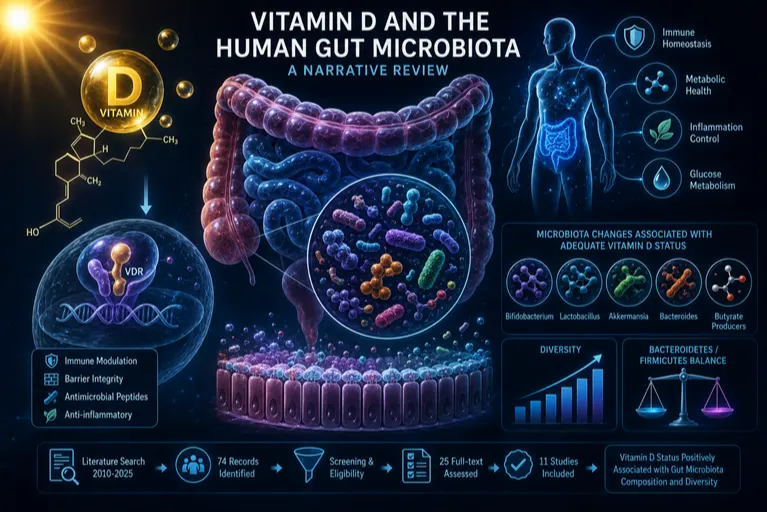
Background: Vitamin D is an endocrine secosteroid with recognized extra-skeletal functions, including modulation of immune responses, epithelial barrier integrity, antimicrobial peptide expression, and inflammatory signaling. In parallel, the intestinal microbiota is increasingly recognized as a metabolic and immunological interface relevant to obesity, diabetes, inflammatory bowel disease, and systemic health. This review evaluates the evidence linking vitamin D status or supplementation to the composition and diversity of the human gut microbiota. Methods: A systematic narrative review was conducted using PubMed, ScienceDirect, and Google Scholar for studies published from 2010 to 2025. Human interventional and observational studies, systematic reviews, and mechanistic reports addressing vitamin D status or supplementation and gut microbiota outcomes were considered. The search and selection process was summarized using a PRISMA-style flow diagram. Findings were synthesized qualitatively because of substantial heterogeneity in populations, vitamin D regimens, microbiome sequencing methods, and reported endpoints. Results: Seventy-four records were identified; after duplicate removal and screening, 25 full-text reports were assessed and 11 evidence sources were retained for detailed synthesis. Higher serum 25-hydroxyvitamin D was generally associated with a more favorable microbiota profile, including greater microbial diversity and enrichment of taxa such as Bifidobacterium, Lactobacillus, Akkermansia, Bacteroides, and butyrate-associated organisms. Randomized supplementation studies showed biologically plausible but inconsistent effects on alpha diversity, beta diversity, and phylum-level changes, particularly the Bacteroidetes/Firmicutes balance. Conclusions: Current evidence supports a plausible vitamin D-gut microbiota axis, but causality remains unproven. Vitamin D supplementation should not yet be considered a targeted microbiota- modifying therapy outside correction of deficiency. Larger standardized randomized trials with integrated metabolomic, endocrine, and clinical endpoints are required.
References
- [1]Bellerba F, Muzio V, Gnagnarella P, Facciotti F, Chiocca S, et al. (2021) The association between vitamin D and gut microbiota: A systematic review of human studies. Nutrients 13: 3378. doi: 10.3390/nu13103378.
- [2]Sekirov I, Russell SL, Antunes LCM, Finlay BB (2010) Gut microbiota in health and disease. Physiol Rev 90: 859-904. doi: 10.1152/physrev.00045.2009.
- [3]Thursby E, Juge N (2017) Introduction to the human gut microbiota. Biochem J 474: 1823-1836. doi: 10.1042/BCJ20160510.
- [4]Lynch SV, Pedersen O (2016) The human intestinal microbiome in health and disease. N Engl J Med 375: 2369-2379. doi: 10.1056/NEJMra1600266.
- [5]Gilbert JA, Blaser MJ, Caporaso JG, Jansson JK, Lynch SV, et al. (2018) Current understanding of the human microbiome. Nat Med 24: 392-400. doi: 10.1038/nm.4517.
- [6]Al-Khaldy NS, Al-Musharaf S, Aljazairy EA, Hussain SD, Alnaami AM, et al. (2023) Serum vitamin D level and gut microbiota in women. Healthcare 11: 351. doi: 10.3390/healthcare11030351.
- [7]Zeb F, Osaili T, Hashim M, Alkalbani N, Papandreou D, et al. (2025) Effect of vitamin D supplementation on human gut microbiota: A systematic review of randomized controlled trials. Nutr Rev: nuaf120. doi: 10.1093/nutrit/nuaf120.
- [8]Naderpoor N, Mousa A, Gomez Arango LF, Barrett HL, Dekker Nitert M, et al. (2019) Effect of vitamin D supplementation on faecal microbiota: A randomised clinical trial. Nutrients 11: 2888. doi: 10.3390/nu11122888.
- [9]Charoenngam N, Shirvani A, Kalajian TA, Song A, Holick MF (2020) The effect of various doses of oral vitamin D3 supplementation on gut microbiota in healthy adults: A randomized, double-blinded, dose-response study. Anticancer Res 40: 551-556. doi: 10.21873/anticanres.13984.
- [10]Bashir M, Prietl B, Tauschmann M, Mautner SI, Kump PK, et al. (2016) Effects of high doses of vitamin D3 on mucosa-associated gut microbiome vary between regions of the human gastrointestinal tract. Eur J Nutr 55: 1479-1489. doi: 10.1007/s00394-015-0966-2.
- [11]Luthold RV, Fernandes GR, Franco-de-Moraes AC, Folchetti LGD, Ferreira SRG (2017) Gut microbiota interactions with the immunomodulatory role of vitamin D in normal individuals. Metabolism 69: 76-86. doi: 10.1016/j.metabol.2017.01.007.
- [12]Assa A, Vong L, Pinnell LJ, Avitzur N, Johnson-Henry KC, et al. (2014) Vitamin D deficiency promotes epithelial barrier dysfunction and intestinal inflammation. J Infect Dis 210: 1296-1305. doi: 10.1093/infdis/jiu235.
- [13]Lagishetty V, Liu NQ, Hewison M (2011) Vitamin D metabolism and innate immunity. Mol Cell Endocrinol 347: 97-105. doi: 10.1016/j.mce.2011.04.027.
- [14]Cantorna MT, Snyder L, Lin YD, Yang L (2015) Vitamin D and 1,25(OH)2D regulation of T cells. Nutrients 7: 3011-3021. doi: 10.3390/nu7043011.
- [15]Singh P, Rawat A, Alwakeel M, Sharif E, Al Khodor S (2020) The potential role of vitamin D supplementation as a gut microbiota modifier in healthy individuals. Sci Rep 10: 21641. doi: 10.1038/s41598-020-77806-4.
- [16]Pham H, Waterhouse M, Rahman S, Baxter C, Duarte Romero B, et al. (2023) The effect of vitamin D supplementation on the gut microbiome in older Australians: Results from analyses of the D-Health Trial. Gut Microbes 15: 2221429. doi: 10.1080/19490976.2023.2221429.
- [17]Thomas RL, Jiang L, Adams JS, Xu ZZ, Shen J, et al. (2020) Vitamin D metabolites and the gut microbiome in older men. Nat Commun 11: 5997. doi: 10.1038/s41467-020-19793-8.
- [18]Wyatt M, Choudhury A, Von Dohlen G, Heileson JL, Forsse JS, et al. (2024) Randomized control trial of moderate dose vitamin D alters microbiota stability and metabolite networks in healthy adults. Microbiol Spectr 12: e00083-24. doi: 10.1128/spectrum.00083-24.
- [19]Ullah H (2025) Gut-vitamin D interplay: Key to mitigating immunosenescence and promoting healthy ageing. Immun Ageing 22: 20. doi: 10.1186/s12979-025-00514-y.
- [20]Wang J, Mei L, Hao Y, Xu Y, Yang Q, et al. (2024) Contemporary perspectives on the role of vitamin D in enhancing gut health and its implications for preventing and managing intestinal diseases. Nutrients 16: 2352. doi: 10.3390/nu16142352.
- [21]Vernia F, Valvano M, Longo S, Cesaro N, Viscido A, et al. (2022) Vitamin D in inflammatory bowel diseases: Mechanisms of action and therapeutic implications. Nutrients 14: 269. doi: 10.3390/nu14020269.
- [22]Aggeletopoulou I, Marangos M, Assimakopoulos SF, Mouzaki A, Thomopoulos K, et al. (2023) Vitamin D and microbiome: Molecular interaction in inflammatory bowel disease pathogenesis. Am J Pathol 193: 770-782. doi: 10.1016/j.ajpath.2023.02.004.
- [23]Tabassum A, Ali A, Zahedi FD, Ismail NAS (2023) Immunomodulatory role of vitamin D on gut microbiome in children. Biomedicines 11: 1441. doi: 10.3390/biomedicines11051441.
- [24]Tangestani H, Boroujeni HK, Djafarian K, Emamat H, Shab-Bidar S (2021) Vitamin D and the gut microbiota: A narrative literature review. Clin Nutr Res 10: 181-191. doi: 10.7762/cnr.2021.10.3.181.
Authors (4)
Om Kolthoum SALLEM
EPS Fattouma BourguibaEPS Fattouma BourguibaEPS Fattouma BourguibaEPS Fattouma Bourguiba
View all publications →Amira GUAROUACHi
University of MonastirUniversity of MonastirUniversity of MonastirUniversity of Monastir
View all publications →Syrine DADAA
EPS Fattouma BourguibaEPS Fattouma BourguibaEPS Fattouma BourguibaEPS Fattouma Bourguiba
View all publications →Yosra HASNi
Farhat Hached University Hospi...Farhat Hached University HospitalFarhat Hached University HospitalFarhat Hached University Hospital
View all publications →Download Article
Summarise this paper with AI:
Article Information
Published in:
July - December 2026 (Vol. 3, Issue 2, 2026)Article Impact
Views:165
Downloads:55
How to Cite
Kolthoum SALLEM, O., GUAROUACHi, A., DADAA, S., & HASNi, Y. (2026). VITAMIN D AND THE HUMAN GUT MICROBIOTA: A NARRATIVE REVIEW Review Article. Advances in Obesity, Endocrinology, and Diabetes, 3(2), 1-12. https://aoeds.com/articles/AOEDS230055
Article Actions
More from this Issue
Genotype phenotype correlation of a homozygous DDX11 variant of uncertain significance in a 21-year-old Sudanese woman with a Warsaw Breakage Syndrome phenotype
Mustafa Alqaysi, Bashar S...Read more →
SGLT2 Inhibitor-Associated Erythrocytosis in Patients with Type 2 Diabetes Mellitus: A Three-Patient Case Series and practical approach to evaluation and management.
Mai Elgoukhy, Seifeldin Y...Read more →
GLP-1 receptor agonists and the immune microbiome infection axis: a narrative review
Ensiyeh rahimi, IHAB el T...Read more →