


Published
GLP-1 receptor agonists and the immune microbiome infection axis: a narrative review
,
Published in July - December 2026 (Vol. 3, Issue 2, 2026)
Keywords
Abstract
Background:
Obesity and type 2 diabetes mellitus (T2DM) are associated with chronic inflammation, immune dysfunction, and as a result increased risk of infections. Glucagon-like peptide-1 receptor agonists (GLP-1 RAs) have emerged as key therapeutic agents with potential pleiotropic effects beyond glycemic control.
Objective:
This narrative review summarizes current evidence on the role of GLP-1 receptor agonists in modulating the immune–microbiome–infection axis and their potential impact on infection risk.
Methods:
A narrative review of recent experimental, clinical, and meta-analytic studies was performed focusing on immune regulation, inflammatory biomarkers, gut microbiota, and infectious outcomes.
Results:
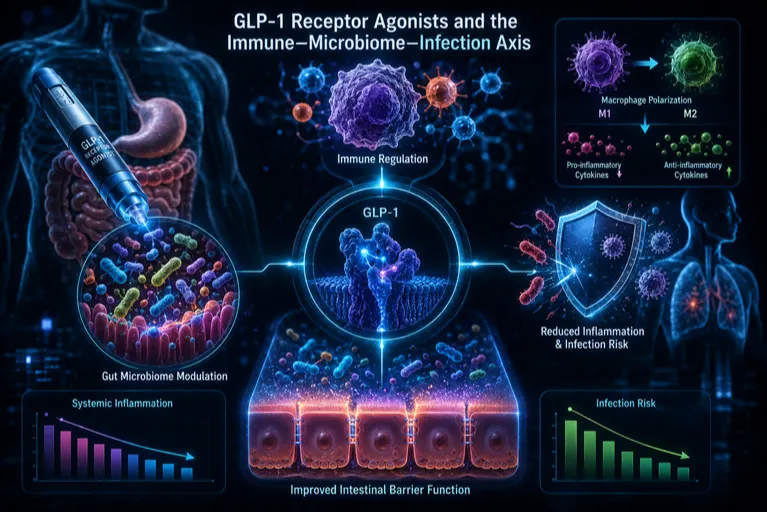
GLP-1 RAs are associated with reduced systemic inflammation and oxidative stress, along with immunomodulatory effects including macrophage polarization and cytokine regulation. Emerging evidence suggests beneficial modulation of gut microbiota composition and improved intestinal barrier function. Studies have shown a reduction in infections, especially respiratory and systemic infections.
Conclusion:
GLP-1 receptor agonists may act as immunometabolic modulators linking metabolic health with immune and microbial homeostasis. Further mechanistic studies are required to clarify their role in infection susceptibility.
References
- [1]Rudd KE, Johnson SC, Agesa KM, et al. Global, regional, and national sepsis incidence and mortality, 1990–2017: analysis for the Global Burden of Disease Study. Lancet. 2020;395(10219):200–211.
- [2]Sun H, Saeedi P, Karuranga S, et al. IDF Diabetes Atlas: Global, regional and country-level diabetes prevalence estimates for 2021 and projections for 2045. Diabetes Res Clin Pract. 2022;183:109119.
- [3]Parab P, Bhatt DK, Shah D, et al. GLP-1 receptor agonists: pleiotropic effects beyond glycemic control. Cureus. 2023;15(9):e45118.
- [4]Patti AM, Giglio RV, Papanas N, et al. Future perspectives of GLP-1 receptor agonists and DPP4 inhibitors in cardiovascular risk reduction. J Clin Med. 2020;9(2):498.
- [5]Patti AM, Giglio RV, Nikolic D, et al. Association of GLP-1 receptor agonists with major adverse cardiovascular events: a meta-analysis. Adv Ther. 2019;36(11):2920–2930.
- [6]Bray JJH, Foster-Davies H, Salem A, et al. Glucagon-like peptide-1 receptor agonists improve biomarkers of inflammation and oxidative stress: a systematic review and meta-analysis of randomised controlled trials. Diabetes Obes Metab. 2021;23(8):1806–1822.
- [7]Masson W, Lobo M, Lavalle-Cobo A, et al. Anti-inflammatory effect of semaglutide: updated systematic review and meta-analysis. Front Cardiovasc Med. 2024;11:1379189.
- [8]Shiraishi D, Fujiwara Y, Komohara Y, et al. Glucagon-like peptide-1 (GLP-1) induces M2 polarization of human macrophages via STAT3 activation. Biochem Biophys Res Commun. 2012;425(2):304–308.
- [9]Mitchell PD, Ahmad R, Rylance PB, et al. Glucagon-like peptide 1 receptor (GLP-1R) expression in human eosinophils. Clin Exp Allergy. 2017;47(3):331–338.
- [10]Hogan AE, Ganopoulos N, Stephens M, et al. Glucagon-like peptide-1 (GLP-1) and the regulation of human invariant natural killer T cells: lessons from obesity, diabetes and beyond. Diabetologia. 2011;54(11):2745–2754.
- [11]Chen J, Ye Y, Liu P, et al. GLP-1 receptor agonist as a modulator of innate immunity. Front Immunol. 2022;13:997578.
- [12]Petakh P, Kamyshnyi A, Oksenych V. Gut microbiota in COVID-19: a systematic review. Viruses. 2023;15(2):336.
- [13]Han S, Xu M, Jiang Z, et al. Effect of glucagon-like peptide-1 receptor agonists on infection risk: a systematic review and meta-analysis of randomised controlled trials. J Infect. 2025;91:106645.
- [14]Holst JJ. GLP-1 physiology in obesity and development of incretin-based drugs for chronic weight management. Nat Metab. 2024;6:1–16.
- [15]Drucker DJ. Mechanisms of action and therapeutic application of glucagon-like peptide-1. Cell Metab. 2018;27(4):740–756.
- [16]Marso SP, Bain SC, Consoli A, et al. Semaglutide and cardiovascular outcomes in patients with type 2 diabetes. N Engl J Med. 2016;375(19):1834–1844.
- [17]Bendotti G, Montefusco L, Pastore I, et al. The anti-inflammatory and immunological properties of GLP-1 receptor agonists. Pharmacol Res. 2022;182:106320.
- [18]Zeng Y, Li S, Cao L, et al. Gut microbiota mediates the anti-obesity effect of GLP-1 receptor agonists. mBio. 2024;15:e02032-23.
- [19]Camilleri M, Lupianez-Merly C, Atieh J, et al. Effects of GLP-1 and other gut hormones on the gut microbiome. Am J Gastroenterol. 2024;119:1028–1037.
- [20]Holst JJ, Rosenkilde MM. GLP-1 receptor agonists as treatment of type 2 diabetes mellitus: mechanisms of action and beyond. Br J Pharmacol. 2022;179:727–742.
- [21]Duan Y, Zhang M, Sun J, et al. Gut microbiome modulation by GLP-1 receptor agonists in obesity and metabolic disease. Front Endocrinol. 2024;15:1375478.
- [22]Koh A, De Vadder F, Kovatcheva-Datchary P, Backhed F. From dietary fiber to host physiology: short-chain fatty acids as key bacterial metabolites. Cell. 2016;165(6):1332–1345.
- [23]Abdalqadir N, Adeli K. GLP-1 and GLP-2 orchestrate intestinal regulatory T cells and innate lymphoid cells. Microorganisms. 2022;10:2061.
- [24]Zeng BS, Zeng BY, Liang CS, et al. Comparative effects of GLP-1 receptor agonists and SGLT2 inhibitors on infection risk: a network meta-analysis. Clin Microbiol Infect. 2026;32(6):889–899.
- [25]Xie Y, Choi T, Al-Aly Z. Mapping the effectiveness and risks of GLP-1 receptor agonists. Nat Med. 2025;31:951–962.
- [26]Morrow NM, Hanson AA, Mulvihill EE. Distinct tissue-specific roles of GLP-1R signaling in metabolic control. Peptides. 2024;172:171120.
Authors (2)
Ensiyeh rahimi
Iranian Institute for Reductio...Iranian Institute for Reduction of High-Risk Behav...Iranian Institute for Reduction of High-Risk BehaviorsIranian Institute for Reduction of High-Risk Behaviors
View all publications →IHAB el Tayeb
Zagazig UniversityZagazig UniversityZagazig UniversityZagazig University
View all publications →Download Article
Summarise this paper with AI:
Article Information
Published in:
July - December 2026 (Vol. 3, Issue 2, 2026)Article Impact
Views:144
Downloads:70
How to Cite
rahimi, E., & el Tayeb, I. (2026). GLP-1 receptor agonists and the immune microbiome infection axis: a narrative review. Advances in Obesity, Endocrinology, and Diabetes, 3(2), 1-16. https://aoeds.com/articles/AOEDS230049
Article Actions
More from this Issue
Genotype phenotype correlation of a homozygous DDX11 variant of uncertain significance in a 21-year-old Sudanese woman with a Warsaw Breakage Syndrome phenotype
Mustafa Alqaysi, Bashar S...Read more →
More by These Authors
Frequency and Risk Factors of Medication Non-Adherence in Elderly Diabetics
2025 • Vol. 2, Issue 1
Read more →