


Published
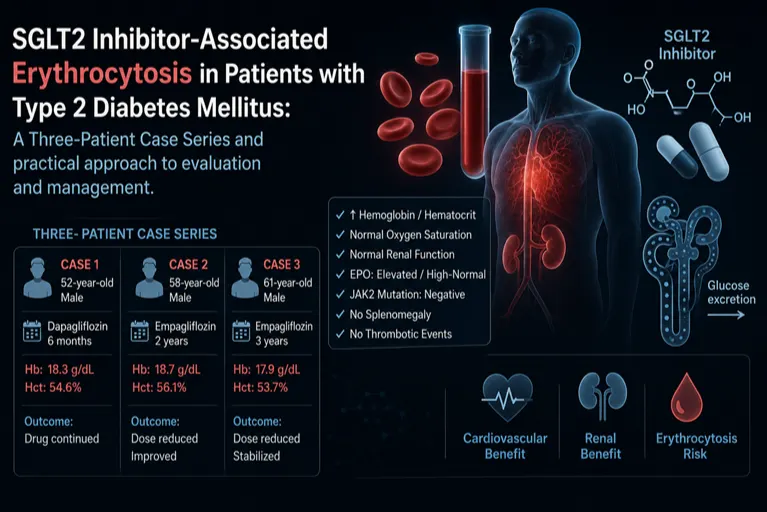
SGLT2 Inhibitor-Associated Erythrocytosis in Patients with Type 2 Diabetes Mellitus: A Three-Patient Case Series and practical approach to evaluation and management.
,
Published in July - December 2026 (Vol. 3, Issue 2, 2026)
Keywords
Abstract
Background
Sodium-glucose cotransporter-2 inhibitors (SGLT2i) have become a cornerstone in the management of type 2 diabetes mellitus (T2DM) because of their established cardiovascular and renal benefits. In addition to improving glycemic control, these agents are associated with increases in hemoglobin and hematocrit levels. While mild hematological changes are commonly observed, clinically significant erythrocytosis remains underrecognized and may prompt investigation for myeloproliferative or secondary causes.(1-2 )
Case Presentations
We describe three male patients with T2DM who developed erythrocytosis while receiving dapagliflozin or empagliflozin. All patients were overweight active smokers and demonstrated elevated hemoglobin and hematocrit levels, preserved renal function, normal oxygen saturation, elevated or upper-normal erythropoietin concentrations, and negative JAK2 mutation testing. No patient demonstrated splenomegaly, hyperviscosity symptoms, or thrombotic complications. One patient developed erythrocytosis within six months of dapagliflozin initiation, whereas two patients developed erythrocytosis during long-term SGLT2 inhibitor therapy. Dose reduction in the latter two cases resulted in stabilization or reduction of hemoglobin levels without treatment discontinuation.
Conclusion
SGLT2 inhibitor-associated erythrocytosis is an increasingly recognized clinical entity that may mimic primary or secondary hematologic disorders. Careful evaluation and individualized management may allow continuation of therapy while preserving its established cardiometabolic benefits.
References
- [1]American Diabetes Association. Standards of Care in Diabetes—2025. Diabetes Care. 2025;48.
- [2]Levin A, Ahmed SB, Carrero JJ, et al. Executive summary of the KDIGO 2024 Clinical Practice Guideline for the Evaluation and Management of Chronic Kidney Disease. Kidney Int. 2024;105(4):684-701.
- [3]Zinman B, Wanner C, Lachin JM, et al. Empagliflozin, cardiovascular outcomes, and mortality in type 2 diabetes. N Engl J Med. 2015;373:2117-2128.
- [4]Neal B, Perkovic V, Mahaffey KW, et al. Canagliflozin and cardiovascular and renal events in type 2 diabetes. N Engl J Med. 2017;377:644-657.
- [5]McMurray JJV, Solomon SD, Inzucchi SE, et al. Dapagliflozin in patients with heart failure and reduced ejection fraction. N Engl J Med. 2019;381:1995-2008.
- [6]Mazer CD, Hare GMT, Connelly PW, et al. Effect of empagliflozin on erythropoietin levels and red blood cell mass. Diabetes Obes Metab. 2020;22:1272-1277.
- [7]Packer M. Mechanisms leading to the hematocrit increase associated with SGLT2 inhibitors. Cardiovasc Diabetol. 2023;22:320.
- [8]Chin-Yee B, Solh Z, Hsia C. Erythrocytosis induced by sodium-glucose cotransporter-2 inhibitors. CMAJ. 2020;192:E1271.
- [9]Chin-Yee B, Hillis C, Lee AYY. SGLT2 inhibitor-associated erythrocytosis: closing the evidence gap. Blood Rev. 2025;74:101363.
- [10]Lewis M, Alcorn J, Weir MA, et al. Sodium-Glucose Cotransporter 2 Inhibitors, Erythrocytosis, and Thromboembolic Risk in Adults With Type 2 Diabetes. JAMA Netw Open. 2025;8(6):e2511449.
- [11]Cases A, Cigarrán S, Górriz JL, Nuñez J. Effect of SGLT2 inhibitors on anemia and their possible clinical implications. Nefrologia (Engl Ed). 2024;44(2):165-172.
- [12]Packer M. Mechanisms of enhanced renal and hepatic erythropoietin synthesis by sodium- glucose cotransporter 2 inhibitors. Eur Heart J. 2023;44(48):5027-5035.
- [13]Gangat N, Szuber N, Alkhateeb H, et al. JAK2 wild-type erythrocytosis associated with sodium-glucose cotransporter 2 inhibitor therapy. Blood. 2021;138:2886-2889.
- [14]Liu J, Chin-Yee B, Ho J, et al. Diagnosis, management, and outcomes of drug-induced erythrocytosis: a systematic review. Blood Adv. 2025;9(8):2108-2118.
- [15]Tefferi A, Barbui T. Polycythemia vera: 2024 update on diagnosis, risk stratification, and management. Am J Hematol. 2024;99(3):507-526
Authors (2)
Mai Elgoukhy
Sheikh Sultan Bin Zayed Hospit...Sheikh Sultan Bin Zayed HospitalSheikh Sultan Bin Zayed HospitalSheikh Sultan Bin Zayed Hospital
View all publications →Seifeldin Yahia
Sheikh Sultan Bin Zayed Hospit...Sheikh Sultan Bin Zayed HospitalSheikh Sultan Bin Zayed HospitalSheikh Sultan Bin Zayed Hospital
View all publications →Download Article
Summarise this paper with AI:
Article Information
Published in:
July - December 2026 (Vol. 3, Issue 2, 2026)Article Impact
Views:281
Downloads:141
How to Cite
Elgoukhy, M., & Yahia, S. (2026). SGLT2 Inhibitor-Associated Erythrocytosis in Patients with Type 2 Diabetes Mellitus: A Three-Patient Case Series and practical approach to evaluation and management.. Advances in Obesity, Endocrinology, and Diabetes, 3(2), 1-7. https://aoeds.com/articles/AOEDS230048
Article Actions
More from this Issue
Genotype phenotype correlation of a homozygous DDX11 variant of uncertain significance in a 21-year-old Sudanese woman with a Warsaw Breakage Syndrome phenotype
Mustafa Alqaysi, Bashar S...Read more →
GLP-1 receptor agonists and the immune microbiome infection axis: a narrative review
Ensiyeh rahimi, IHAB el T...Read more →