


Published
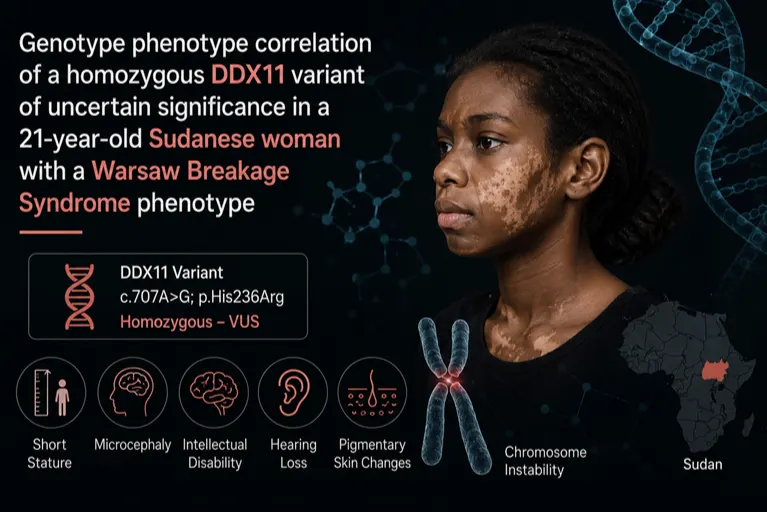
Genotype phenotype correlation of a homozygous DDX11 variant of uncertain significance in a 21-year-old Sudanese woman with a Warsaw Breakage Syndrome phenotype
, ,
Published in July - December 2026 (Vol. 3, Issue 2, 2026)
Keywords
Abstract
Warsaw Breakage Syndrome (WABS) is a rare autosomal recessive chromosome instability disorder caused by biallelic pathogenic variants in DDX11 [1]. It is characterised by growth restriction, microcephaly, intellectual disability and sensorineural hearing loss [1,4,5]. We report a 21-year-old Sudanese woman with severe proportionate short stature, microcephaly, intellectual disability, hearing loss and pigmentary skin changes. Genetic testing identified a homozygous DDX11 missense variant (c.707A>G; p.His236Arg), classified as a variant of uncertain significance (VUS). Despite uncertain classification, the phenotype is highly suggestive of WABS. This case highlights the importance of clinical correlation in interpreting VUS findings in rare cohesinopathies [5,8].
References
- [1]van der Lelij P, Chrzanowska KH, Godthelp BC, et al. Warsaw breakage syndrome, a cohesinopathy associated with mutations in the DNA helicase DDX11. Am J Hum Genet. 2010;86:262–266.
- [2]Capo-Chichi JM, Bharti SK, Sommers JA, et al. Identification and biochemical characterization of a novel mutation in DDX11 causing Warsaw breakage syndrome. Hum Mutat. 2013;34:103–107.
- [3]Bharti SK, Khan I, Banerjee T, et al. Molecular functions and cellular roles of the ChlR1/DDX11 DNA helicase defective in Warsaw breakage syndrome. Cell Mol Life Sci. 2014;71:2625–2639.
- [4]Eppley HE, Mendelsohn BA, Slavotinek AM. Warsaw breakage syndrome associated with novel DDX11 mutations and cochlear anomalies. Am J Med Genet A. 2017;173:238–245.
- [5]Alkhunaizi E, Shaheen R, Bharti SK, et al. Warsaw breakage syndrome: further clinical and genetic delineation. Am J Med Genet A. 2018;176:2404–2418.
- [6]Pisani FM, Napolitano E, Napolitano LMR, Onesti S. Molecular and cellular functions of the Warsaw breakage syndrome DNA helicase DDX11. Genes (Basel). 2018;9:564.
- [7]Bailey C, Fryer A, Greenslade M. Two further patients with Warsaw breakage syndrome: is a mild phenotype possible? Clin Genet. 2019;95:315–317.
- [8]Chrzanowska KH, Gregorek H, Dembowska-Bagińska B, et al. Warsaw breakage syndrome. In: Adam MP, Mirzaa GM, Pagon RA, eds. GeneReviews®. Seattle: University of Washington; updated periodically.
Authors (3)
Malak AlMukhtar
Queen’s University BelfastQueen’s University BelfastQueen’s University BelfastQueen’s University Belfast
View all publications →Download Article
Summarise this paper with AI:
Article Information
Published in:
July - December 2026 (Vol. 3, Issue 2, 2026)Article Impact
Views:246
Downloads:71
How to Cite
Alqaysi, M., Sahar, B., & AlMukhtar, M. (2026). Genotype phenotype correlation of a homozygous DDX11 variant of uncertain significance in a 21-year-old Sudanese woman with a Warsaw Breakage Syndrome phenotype. Advances in Obesity, Endocrinology, and Diabetes, 3(2), 1-4. https://aoeds.com/articles/AOEDS230047
Article Actions
More from this Issue
SGLT2 Inhibitor-Associated Erythrocytosis in Patients with Type 2 Diabetes Mellitus: A Three-Patient Case Series and practical approach to evaluation and management.
Mai Elgoukhy, Seifeldin Y...Read more →
GLP-1 receptor agonists and the immune microbiome infection axis: a narrative review
Ensiyeh rahimi, IHAB el T...Read more →