


Published
Gut Microbiota in Type 2 Diabetes: Dysbiosis Signatures, Metabolic Signalling, and Microbiome-Targeted Therapeutics
, ,
Published in July - December 2026 (Vol. 3, Issue 2, 2026)
Keywords
Abstract
Introduction: Type 2 diabetes is a complex endocrine-metabolic disorder in which insulin resistance, beta-cell dysfunction, chronic low-grade inflammation and environmental exposures interact. The gut microbiota has emerged as a biologically plausible determinant of this process because it regulates nutrient fermentation, microbial metabolite production, gut barrier integrity, immune tone and endocrine-metabolic signalling.
Methods:
A structured review of the literature was conducted using PubMed/MEDLINE, ScienceDirect and Google Scholar. English and French publications were screened using terms related to gut microbiota, type 2 diabetes, dysbiosis, insulin resistance, inflammation, probiotics, prebiotics, microbiota-targeted therapy and fecal microbiota transplantation. Forty-two records were identified, and 32 references were retained for qualitative synthesis after screening and full-text eligibility assessment.
Results:
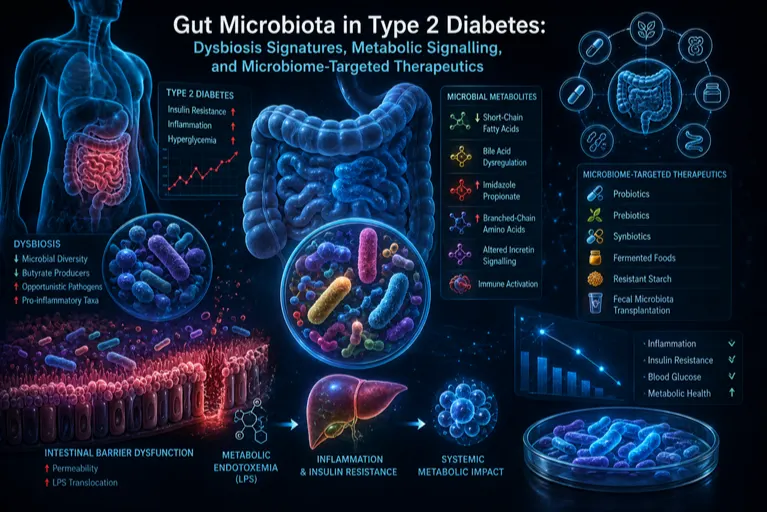
The evidence consistently indicates that type 2 diabetes is associated with dysbiosis, reduced microbial diversity, depletion of butyrate-producing or metabolically favorable taxa and enrichment of opportunistic or pro-inflammatory communities. Recurrent mechanisms include intestinal barrier dysfunction, lipopolysaccharide-mediated metabolic endotoxemia, impaired short-chain fatty acid signalling, bile acid dysregulation, excessive imidazole propionate, branched-chain amino acid metabolism, altered incretin responses and immune-metabolic activation. Microbiota-targeted interventions, including fermented foods, probiotics, prebiotics, synbiotics, resistant starch and fecal microbiota transplantation, show promise but remain clinically heterogeneous.
Conclusion:
The gut microbiota is best understood as a dynamic metabolic interface rather than a passive marker of type 2 diabetes. Microbiome-informed strategies may enrich future precision endocrinology, but standardised human trials integrating taxonomic, functional and clinical endpoints are required before routine implementation.
References
- [1]Fu Y, Li S, Xiao Y, Liu G, Fang J. A metabolite perspective on the involvement of the gut microbiota in type 2 diabetes. Int J Mol Sci. 2023;24:14991.
- [2]Liu N, Yan X, Lv B, Wu Y, Hu X, Zheng C, et al. A study on the association between gut microbiota, inflammation, and type 2 diabetes. Appl Microbiol Biotechnol. 2024;108:213.
- [3]Gurung M, Li Z, You H, Rodrigues R, Jump DB, Morgun A, et al. Role of gut microbiota in type 2 diabetes pathophysiology. EBioMedicine. 2020;51:102590.
- [4]Krautkramer KA, Fan J, Backhed F. Gut microbial metabolites as multi-kingdom intermediates. Nat Rev Microbiol. 2021;19:77-94.
- [5]Qin J, Li Y, Cai Z, Li S, Zhu J, Zhang F, et al. A metagenome-wide association study of gut microbiota in type 2 diabetes. Nature. 2012;490:55-60.
- [6]Koh A, Molinaro A, Stahlman M, Khan MT, Schmidt C, Manneras-Holm L, et al. Microbially produced imidazole propionate impairs insulin signaling through mTORC1. Cell. 2018;175:947-961.e17.
- [7]Pedersen HK, Gudmundsdottir V, Nielsen HB, Hyotylainen T, Nielsen T, Jensen BAH, et al. Human gut microbes impact host serum metabolome and insulin sensitivity. Nature. 2016;535:376-381.
- [8]Larsen N, Vogensen FK, van den Berg FWJ, Nielsen DS, Andreasen AS, Pedersen BK, et al. Gut microbiota in human adults with type 2 diabetes differs from non-diabetic adults. PLoS One. 2010;5:e9085.
- [9]Salamon D. Characteristics of gut microbiota in adult patients with type 1 and type 2 diabetes based on next-generation sequencing of the 16S rRNA gene fragment. Pol Arch Intern Med. 2020.
- [10]Mei Z, Wang F, Bhosle A, Dong D, Mehta R, Ghazi A, et al. Strain-specific gut microbial signatures in type 2 diabetes identified in a cross-cohort analysis of 8,117 metagenomes. Nat Med. 2024;30:2265-2276. doi:10.1038/s41591-024-03067-7.
- [11]Karlsson FH, Tremaroli V, Nookaew I, Bergstrom G, Behre CJ, Fagerberg B, et al. Gut metagenome in European women with normal, impaired and diabetic glucose control. Nature. 2013;498:99-103.
- [12]Yorulmaz G, Kalkan AT, Akalin A, Varis A, Kaya M, Dinleyici EC. Intestinal microbiota composition in patients with type 2 diabetes and effects of 12 weeks of oral anti-diabetic treatment. J Endocr Soc. 2022;6(Suppl 1):A427. doi:10.1210/jendso/bvac150.888.
- [13]Doumatey AP, Adeyemo A, Zhou J, Lei L, Adebamowo SN, Adebamowo C, et al. Gut microbiome profiles are associated with type 2 diabetes in urban Africans. Front Cell Infect Microbiol. 2020;10:63.
- [14]Corb Aron RA, Tit DM, Moleriu R, Bungau S, Toma MM, et al. Particularities of the intestinal microbiome composition in Romanian patients with metabolic syndrome and type 2 diabetes. Arch Balk Med Union. 2021;56:413-421.
- [15]Ghaemi F, Fateh A, Sepahy AA, Zangeneh M, Ghanei M, Siadat SD. Intestinal microbiota composition in Iranian diabetic, pre-diabetic and healthy individuals. J Diabetes Metab Disord. 2020;19:1199-1203.
- [16]Balvers M, Deschasaux M, van den Born BJ, Zwinderman K, Nieuwdorp M, Levin E. Analyzing type 2 diabetes associations with the gut microbiome in individuals from two ethnic backgrounds living in the same geographic area. Nutrients. 2021;13:3289.
- [17]Que Y, Cao M, He J, Zhang Q, Chen Q, Yan C, et al. Gut bacterial characteristics of patients with type 2 diabetes mellitus and the application potential. Front Immunol. 2021;12:722206.
- [18]Lippert K, Kedenko L, Antonielli L, Kedenko I, Gemeier C, Leitner M, et al. Gut microbiota dysbiosis associated with glucose metabolism disorders and the metabolic syndrome in older adults. Benef Microbes. 2017;8:545-556.
- [19]Ni Y, Mu C, He X, Zheng K, Guo H, Zhu W. Characteristics of gut microbiota and its response to a Chinese herbal formula in elder patients with metabolic syndrome. Drug Discov Ther. 2018;12:161-169.
- [20]Sedighi M, Razavi S, Navab-Moghadam F, Khamseh ME, Alaei-Shahmiri F, Mehrtash A, et al. Comparison of gut microbiota in adult patients with type 2 diabetes and healthy individuals. Microb Pathog. 2017;111:362-369.
- [21]Plovier H, Everard A, Druart C, Depommier C, Van Hul M, Geurts L, et al. A purified membrane protein from Akkermansia muciniphila or the pasteurized bacterium improves metabolism in obese and diabetic mice. Nat Med. 2017;23:107-113.
- [22]Zhao Y, Yang H, Wu P, Yang S, Xue W, Xu B, et al. Akkermansia muciniphila: a promising probiotic against inflammation and metabolic disorders. Virulence. 2024;15:2375555.
- [23]Dong Y, Wang P, Yang X, Chen M, Li J. Potential of gut microbiota for lipopolysaccharide biosynthesis in European women with type 2 diabetes based on metagenome. Front Cell Dev Biol. 2022;10:1027413.
- [24]Salguero M, Al-Obaide M, Singh R, Siepmann T, Vasylyeva T. Dysbiosis of Gram-negative gut microbiota and the associated serum lipopolysaccharide exacerbates inflammation in type 2 diabetic patients with chronic kidney disease. Exp Ther Med. 2019;18:3461-3469.
- [25]Funabashi M, Grove TL, Wang M, Varma Y, McFadden ME, Brown LC, et al. A metabolic pathway for bile acid dehydroxylation by the gut microbiome. Nature. 2020;582:566-570.
- [26]Nie Q, Luo X, Wang K, Ding Y, Jia S, Zhao Q, et al. Gut symbionts alleviate MASH through a secondary bile acid biosynthetic pathway. Cell. 2024;187:2717-2734.e33.
- [27]Cox AJ, Zhang P, Bowden DW, Devereaux B, Davoren PM, Cripps AW, et al. Increased intestinal permeability as a risk factor for type 2 diabetes. Diabetes Metab. 2017;43:163-166.
- [28]Zhong H, Wang L, Jia F, Yan Y, Xiong F, Hidayat K, et al. Effect of probiotic fermented milk supplementation on glucose and lipid metabolism parameters and inflammatory markers in patients with type 2 diabetes mellitus: a meta-analysis of randomized controlled trials. Biology. 2024;13:641.
- [29]Hove KD, Brons C, Faerch K, Lund SS, Rossing P, Vaag A. Effects of 12 weeks of treatment with fermented milk on blood pressure, glucose metabolism and markers of cardiovascular risk in patients with type 2 diabetes: a randomised double-blind placebo-controlled study. Eur J Endocrinol. 2015;172:11-20.
- [30]Bodinham CL, Smith L, Thomas EL, Bell JD, Swann JR, Costabile A, et al. Efficacy of increased resistant starch consumption in human type 2 diabetes. Endocr Connect. 2014;3:75-84.
- [31]Velayati A, Kareem I, Sedaghat M, Sohrab G, Nikpayam O, Hedayati M, et al. The effects of synbiotic supplementation on metabolic factors and systemic inflammation in patients with type 2 diabetes: a randomized, double-blind, placebo-controlled study. 2020.
- [32]Ding D, Yong H, You N, Lu W, Yang X, Ye X, et al. Prospective study reveals host microbial determinants of clinical response to fecal microbiota transplant therapy in type 2 diabetes patients. Front Cell Infect Microbiol. 2022;12:820367.
Authors (3)
Om Kolthoum SALLEM
EPS Fattouma BourguibaEPS Fattouma BourguibaEPS Fattouma BourguibaEPS Fattouma Bourguiba
View all publications →Dorra BENSALEM
University of MonastirUniversity of MonastirUniversity of MonastirUniversity of Monastir
View all publications →Yosra HASNI
University of MonastirUniversity of MonastirUniversity of MonastirUniversity of Monastir
View all publications →Download Article
Summarise this paper with AI:
Article Information
Published in:
July - December 2026 (Vol. 3, Issue 2, 2026)Article Impact
Views:148
Downloads:140
How to Cite
Kolthoum SALLEM, O., BENSALEM, D., & HASNI, Y. (2026). Gut Microbiota in Type 2 Diabetes: Dysbiosis Signatures, Metabolic Signalling, and Microbiome-Targeted Therapeutics. Advances in Obesity, Endocrinology, and Diabetes, 3(2), 1-16. https://aoeds.com/articles/AOEDS230054
Article Actions
More from this Issue
Genotype phenotype correlation of a homozygous DDX11 variant of uncertain significance in a 21-year-old Sudanese woman with a Warsaw Breakage Syndrome phenotype
Mustafa Alqaysi, Bashar S...Read more →
SGLT2 Inhibitor-Associated Erythrocytosis in Patients with Type 2 Diabetes Mellitus: A Three-Patient Case Series and practical approach to evaluation and management.
Mai Elgoukhy, Seifeldin Y...Read more →
GLP-1 receptor agonists and the immune microbiome infection axis: a narrative review
Ensiyeh rahimi, IHAB el T...Read more →