


Published
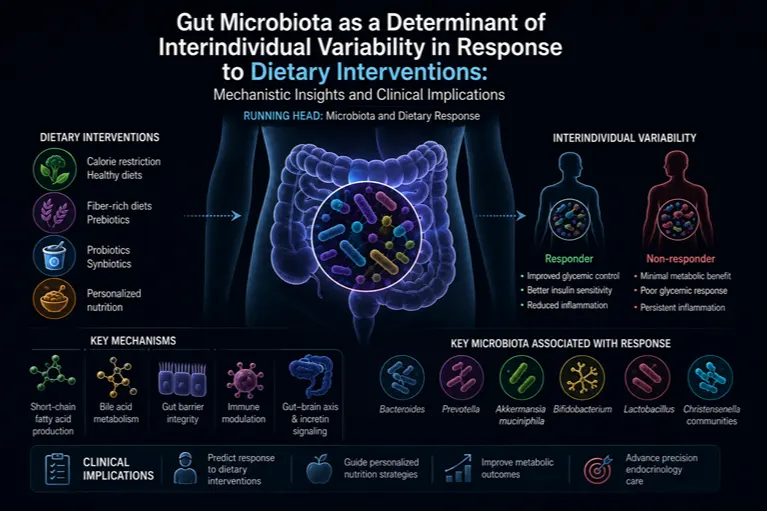
Gut Microbiota as a Determinant of Interindividual Variability in Response to Dietary Interventions: Mechanistic Insights and Clinical Implications Running head: Microbiota and Dietary Response
,
Published in July - December 2026 (Vol. 3, Issue 2, 2026)
Keywords
Abstract
Introduction: Dietary interventions are central to the management of obesity, insulin resistance, type 2 diabetes and related cardiometabolic disorders, yet clinical responses vary substantially between individuals exposed to apparently similar nutritional prescriptions. The gut microbiota may explain part of this variability because it transforms dietary substrates into bioactive metabolites and influences intestinal, immune and endocrine pathways. Methods: A narrative review informed by a structured literature search was conducted using PubMed, ScienceDirect and Google Scholar. Search terms combined concepts related to gut microbiota, intestinal microbiota, dietary intervention, nutrition, fiber, prebiotics, probiotics, metabolic response, obesity, insulin sensitivity and glycemic response. Forty records were initially identified, and 21 references were retained for qualitative synthesis after duplicate removal, screening and full-text eligibility assessment. Results: The reviewed literature indicates that baseline microbial diversity, community structure and functional capacity are associated with differential metabolic responses to calorie restriction, fiber-rich dietary patterns, probiotics, prebiotics and glycemia-oriented personalized nutrition. Key taxa and communities discussed in the evidence include Bacteroides, Prevotella, Akkermansia muciniphila, Bifidobacterium, Lactobacillus and Christensenella-associated communities. Mechanistic pathways include short-chain fatty acid generation, bile acid transformation, tryptophan-derived signaling, incretin-related pathways, epithelial barrier integrity and low-grade inflammation. Conclusion: The gut microbiota should be regarded as both a biomarker and a potential mediator of response to dietary interventions. Microbiota-informed nutrition is promising for precision diabetes and endocrinology care, but standardized prospective studies integrating microbiome profiling with robust metabolic outcomes remain necessary before routine clinical implementation.
References
- [1]Sender R, Fuchs S, Milo R. Are we really vastly outnumbered? Revisiting the ratio of bacterial to host cells in humans. Cell. 2016;164(3):337-340. doi:10.1016/j.cell.2016.01.013.
- [2]Goodrich JK, Waters JL, Poole AC, Sutter JL, Koren O, Blekhman R, et al. Human genetics shape the gut microbiome. Cell. 2014;159(4):789-799. doi:10.1016/j.cell.2014.09.053.
- [3]David LA, Maurice CF, Carmody RN, Gootenberg DB, Button JE, Wolfe BE, et al. Diet rapidly and reproducibly alters the human gut microbiome. Nature. 2014;505(7484):559-563. doi:10.1038/nature12820.
- [4]Zeevi D, Korem T, Zmora N, Israeli D, Rothschild D, Weinberger A, et al. Personalized nutrition by prediction of glycemic responses. Cell. 2015;163(5):1079-1094. doi:10.1016/j.cell.2015.11.001.
- [5]Le Chatelier E, Nielsen T, Qin J, Prifti E, Hildebrand F, Falony G, et al. Richness of human gut microbiome correlates with metabolic markers. Nature. 2013;500(7464):541-546. doi:10.1038/nature12506.
- [6]Magne F, Gotteland M, Gauthier L, Zazueta A, Pesoa S, Navarrete P, Balamurugan R. The Firmicutes/Bacteroidetes ratio: A relevant marker of gut dysbiosis in obese patients? Nutrients. 2020;12(5):1474. doi:10.3390/nu12051474.
- [7]Zhu L, Baker SS, Gill C, Liu W, Alkhouri R, Baker RD, et al. Characterization of gut microbiomes in nonalcoholic steatohepatitis patients: A connection between endogenous alcohol and NASH. Hepatology. 2013;57(2):601-609. doi:10.1002/hep.26093.
- [8]Vrieze A, Van Nood E, Holleman F, Salojärvi J, Kootte RS, Bartelsman JF, et al. Transfer of intestinal microbiota from lean donors increases insulin sensitivity in individuals with metabolic syndrome. Gastroenterology. 2012;143(4):913-916.e7. doi:10.1053/j.gastro.2012.06.031.
- [9]Everard A, Belzer C, Geurts L, Ouwerkerk JP, Druart C, Bindels LB, et al. Cross-talk between Akkermansia muciniphila and intestinal epithelium controls diet-induced obesity. Proc Natl Acad Sci U S A. 2013;110(22):9066-9071. doi:10.1073/pnas.1219451110.
- [10]Xiao L, Pan W, Zhao M, Duan M, Lee YK, Zhang H, et al. A catalog of the mouse gut metagenome. Nat Biotechnol. 2015;33(10):1103-1108. doi:10.1038/nbt.3353.
- [11]He Y, Wu W, Zheng HM, Li P, McDonald D, Sheng HF, et al. Regional variation limits applications of healthy gut microbiome reference ranges and disease models. Nat Med. 2018;24(10):1532-1535. doi:10.1038/s41591-018-0164-x.
- [12]Koh A, De Vadder F, Kovatcheva-Datchary P, Bäckhed F. From dietary fiber to host physiology: Short-chain fatty acids as key bacterial metabolites. Cell. 2016;165(6):1332-1345. doi:10.1016/j.cell.2016.05.041.
- [13]Furusawa Y, Obata Y, Fukuda S, Endo TA, Nakato G, Takahashi D, et al. Commensal microbe-derived butyrate induces the differentiation of colonic regulatory T cells. Nature. 2013;504(7480):446-450. doi:10.1038/nature12721.
- [14]Kobyliak N, Conte C, Cammarota G, Haley AP, Styriak I, Gaspar L, et al. Probiotics in prevention and treatment of obesity: A critical view. Nutr Metab (Lond). 2016;13:14. doi:10.1186/s12986-016-0067-0.
- [15]Slavin JL. Dietary fiber and body weight. Nutrition. 2013;29(7-8):1031-1035. doi:10.1016/j.nut.2013.01.012.
- [16]Sanders ME, Merenstein DJ, Reid G, Gibson GR, Rastall RA. Probiotics and prebiotics in intestinal health and disease: From biology to the clinic. Nat Rev Gastroenterol Hepatol. 2019;16(10):605-616. doi:10.1038/s41575-019-0173-3.
- [17]Suez J, Zmora N, Zilberman-Schapira G, Elinav E. Probiotics and personalized nutrition. Nat Rev Gastroenterol Hepatol. 2019;16(12):706-707. doi:10.1038/s41575-019-0224-9.
- [18]Pedersen HK, Gudmundsdottir V, Nielsen HB, Hyotylainen T, Nielsen T, Jensen BAH, et al. Human gut microbes impact host serum metabolome and insulin sensitivity. Nature. 2016;535(7612):376-381. doi:10.1038/nature18646.
- [19]Vily-Petit J, Mithieux G. Le rôle de l’intestin et du microbiote dans les fonctions métaboliques. Med Mal Metab. 2024;18(7):566-570. doi:10.1016/j.mmm.2024.09.002.
- [20]Schlienger JL. Histoire du microbiote, déterminant des maladies métaboliques. Med Mal Metab. 2024;18(2):162-169. doi:10.1016/j.mmm.2023.09.003.
- [21]Biscarrat P. Exploration approfondie des interactions entre des prébiotiques et une sélection de bactéries intestinales pertinentes pour la santé [doctoral thesis]. Université Paris-Saclay; 2023. Available from: https://theses.hal.science/tel-04277243/.
Authors (2)
Om Kolthoum Sallem
EPS Fattouma BourguibaEPS Fattouma BourguibaEPS Fattouma BourguibaEPS Fattouma Bourguiba
View all publications →Yosra Hasni
Farhat Hached University Hospi...Farhat Hached University HospitalFarhat Hached University HospitalFarhat Hached University Hospital
View all publications →Download Article
Summarise this paper with AI:
Article Information
Published in:
July - December 2026 (Vol. 3, Issue 2, 2026)Article Impact
Views:111
Downloads:50
How to Cite
Kolthoum Sallem, O., & Hasni, Y. (2026). Gut Microbiota as a Determinant of Interindividual Variability in Response to Dietary Interventions: Mechanistic Insights and Clinical Implications Running head: Microbiota and Dietary Response. Advances in Obesity, Endocrinology, and Diabetes, 3(2), 1-13. https://aoeds.com/articles/AOEDS230053
Article Actions
More from this Issue
Genotype phenotype correlation of a homozygous DDX11 variant of uncertain significance in a 21-year-old Sudanese woman with a Warsaw Breakage Syndrome phenotype
Mustafa Alqaysi, Bashar S...Read more →
SGLT2 Inhibitor-Associated Erythrocytosis in Patients with Type 2 Diabetes Mellitus: A Three-Patient Case Series and practical approach to evaluation and management.
Mai Elgoukhy, Seifeldin Y...Read more →
GLP-1 receptor agonists and the immune microbiome infection axis: a narrative review
Ensiyeh rahimi, IHAB el T...Read more →