


Published
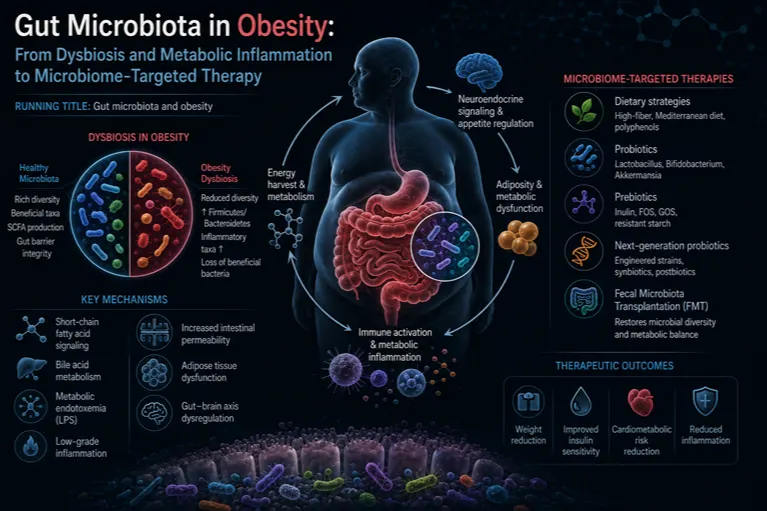
Gut Microbiota in Obesity: From Dysbiosis and Metabolic Inflammation to Microbiome- Targeted Therapy Running title: Gut microbiota and obesity
, ,
Published in July - December 2026 (Vol. 3, Issue 2, 2026)
Keywords
Abstract
Background: Obesity is a chronic endocrine-metabolic disease characterized by excess adiposity, metabolic inflammation and a high burden of cardiometabolic complications. The gut microbiota has emerged as a biologically plausible determinant of obesity because it regulates energy harvest, gut barrier integrity, immune signaling, bile acid metabolism and appetite-related neuroendocrine pathways.
Methods: A structured literature search was conducted in PubMed/MEDLINE, ScienceDirect and Google Scholar for publications from 2000 to 2024 using English and French terms related to obesity, gut microbiota, dysbiosis, inflammation, probiotics, prebiotics, fecal microbiota transplantation, microbiota-targeted therapy and energy metabolism. Systematic reviews, meta- analyses, randomized trials, observational studies and mechanistic investigations were eligible when they addressed microbiota composition, obesity-related mechanisms or microbiome-based therapeutic strategies.
Results: Seventy-two records were initially identified. After duplicate removal, 40 records were screened and 26 full-text publications were retained for qualitative synthesis. Obesity was frequently associated with reduced microbial richness, altered Firmicutes and Bacteroidetes profiles, enrichment of inflammatory taxa and depletion of potentially beneficial organisms such as Akkermansia muciniphila, Bifidobacterium and Faecalibacterium prausnitzii. The principal mechanisms involve short-chain fatty acid signaling, bile acid transformation, metabolic endotoxemia, low-grade inflammation, altered intestinal permeability, adipose-tissue dysfunction and gut-brain axis dysregulation. Dietary strategies, probiotics, prebiotics, next-generation probiotics and fecal microbiota transplantation show therapeutic potential, although clinical efficacy remains heterogeneous.
Conclusion: The gut microbiota is not merely an associated biomarker of obesity but a dynamic metabolic interface that may influence disease expression and therapeutic response. Microbiome- targeted approaches are promising for future precision obesity care, but routine clinical implementation requires standardized, adequately powered and mechanistically informed human trials.
References
- [1]Zhang L, Wang P, Huang J, Xing Y, Wong FS, Suo J, et al. Gut microbiota and therapy for obesity and type 2 diabetes. Front Endocrinol. 2024;15:1333778.
- [2]Pinart M, Doetsch A, Schlicht K, Laudes M, Bouwman J, Forslund SK, et al. Gut microbiome composition in obese and non-obese persons: a systematic review and meta-analysis. Nutrients. 2021;14:12.
- [3]Morgado MC, Sousa M, Coelho AB, et al. Exploring gut microbiota and the influence of physical activity interventions on overweight and obese children and adolescents: a systematic review. Healthcare. 2023;11:2459.
- [4]Gong J, Shen Y, Zhang H, Cao M, Guo M, He J, et al. Gut microbiota characteristics of people with obesity by meta-analysis of existing datasets. Nutrients. 2022;14:2993.
- [5]Pinto AC, Cavalcante DEC, Araujo EA, Cabral FM, Santos JM, Costa KV. Dysbiosis and obesity: implications of the gut microbiota. Int J Nutrology. 2021;14.
- [6]Crovesy L, Masterson D, Rosado EL. Profile of the gut microbiota of adults with obesity: a systematic review. Eur J Clin Nutr. 2020;74:1251-1262.
- [7]Vallianou N, Stratigou T, Christodoulatos GS, Dalamaga M. Understanding the role of the gut microbiome and microbial metabolites in obesity and obesity-associated metabolic disorders: current evidence and perspectives. Curr Obes Rep. 2019;8:317-332.
- [8]Leonario-Rodriguez M, Saavedra N. Microbiota intestinal y modulacion del tejido adiposo en la patogenesis de la obesidad. Arch Latinoam Nutr. 2022;72:100-108.
- [9]Joyce SA, Gahan CGM. The gut microbiota and the metabolic health of the host. Curr Opin Gastroenterol. 2014;30:120-127.
- [10]Saad MJA, Santos A, Prada PO. Linking gut microbiota and inflammation to obesity and insulin resistance. Physiology. 2016;31:283-293.
- [11]Galmiche M, Dechelotte P. Role de l'axe microbiote-intestin-cerveau dans la deregulation du comportement alimentaire au cours de l'obesite et de l'hyperphagie boulimique: les mecanismes. Nutr Clin Metabolisme. 2023;37:2S16-25.
- [12]Breton J, Galmiche M, Dechelotte P. Dysbiotic gut bacteria in obesity: an overview of the metabolic mechanisms and therapeutic perspectives of next-generation probiotics. Microorganisms. 2022;10:452.
- [13]Schele E, Grahnemo L, Anesten F, Hallen A, Backhed F, Jansson JO. The gut microbiota reduces leptin sensitivity and the expression of the obesity-suppressing neuropeptides proglucagon and brain-derived neurotrophic factor in the central nervous system. Endocrinology. 2013;154:3643-3651.
- [14]Lecerf JM. Prebiotiques, flore intestinale, inflammation, obesite. Phytotherapie. 2011;9:106-112.
- [15]Kasubuchi M, Hasegawa S, Hiramatsu T, Ichimura A, Kimura I. Dietary gut microbial metabolites, short-chain fatty acids, and host metabolic regulation. Nutrients. 2015;7:2839-2849.
- [16]Wei M, Huang F, Zhao L, Zhang Y, Yang W, Wang S, et al. A dysregulated bile acid-gut microbiota axis contributes to obesity susceptibility. EBioMedicine. 2020;55:102766.
- [17]Seganfredo FB, Blume CA, Moehlecke M, Giongo A, Casagrande DS, Spolidoro JVN, et al. Weight-loss interventions and gut microbiota changes in overweight and obese patients: a systematic review. Obes Rev. 2017;18:832-851.
- [18]Caputo M, Pigni S, Antoniotti V, Agosti E, Caramaschi A, Antonioli A, et al. Targeting microbiota in dietary obesity management: a systematic review on randomized control trials in adults. Crit Rev Food Sci Nutr. 2023;63:11449-11481.
- [19]Ejtahed HS, Soroush AR, Siadat SD, Hoseini-Tavassol Z, Larijani B, Hasani-Ranjbar S. Targeting obesity management through gut microbiota modulation by herbal products: a systematic review. Complement Ther Med. 2019;42:184-204.
- [20]Tome-Castro XM, Rodriguez-Arrastia M, Cardona D, Rueda-Ruzafa L, Molina-Torres G, Roman P. Probiotics as a therapeutic strategy in obesity and overweight: a systematic review. Benef Microbes. 2021;12:5-16.
- [21]Mazloom K, Siddiqi I, Covasa M. Probiotics: how effective are they in the fight against obesity? Nutrients. 2019;11:258.
- [22]Mazier W, Le Corf K, Martinez C, Tudela H, Kissi D, Kropp C, et al. A new strain of Christensenella minuta as a potential biotherapy for obesity and associated metabolic diseases. Cells. 2021;10:823.
- [23]Zhang Z, Mocanu V, Cai C, Dang J, Slater L, Deehan EC, et al. Impact of fecal microbiota transplantation on obesity and metabolic syndrome: a systematic review. Nutrients. 2019;11:2291.
- [24]Vazquez-Marroquin G, Ochoa-Precoma R, Porchia LM, Perez-Fuentes R, Nicolas-Toledo L, Rodriguez-Antolin J, et al. The effect of microbiome therapies on waist circumference in patients with type 2 diabetes: a systematic review and meta-analysis of randomized controlled trials. J Acad Nutr Diet. 2023;123:933-952.e1.
- [25]Kootte RS, Vrieze A, Holleman F, Dallinga-Thie GM, Zoetendal EG, de Vos WM, et al. The therapeutic potential of manipulating gut microbiota in obesity and type 2 diabetes mellitus. Diabetes Obes Metab. 2012;14:112-120.
Authors (3)
Om Kolthoum SALLEM
EPS Fattouma BourguibaEPS Fattouma BourguibaEPS Fattouma BourguibaEPS Fattouma Bourguiba
View all publications →Salma MOHSEN
University of MonastirUniversity of MonastirUniversity of MonastirUniversity of Monastir
View all publications →Sirine DADAA
EPS Fattouma BourguibaEPS Fattouma BourguibaEPS Fattouma BourguibaEPS Fattouma Bourguiba
View all publications →Download Article
Summarise this paper with AI:
Article Information
Published in:
July - December 2026 (Vol. 3, Issue 2, 2026)Article Impact
Views:160
Downloads:73
How to Cite
Kolthoum SALLEM, O., MOHSEN, S., & DADAA, S. (2026). Gut Microbiota in Obesity: From Dysbiosis and Metabolic Inflammation to Microbiome- Targeted Therapy Running title: Gut microbiota and obesity. Advances in Obesity, Endocrinology, and Diabetes, 3(2), 1-18. https://aoeds.com/articles/AOEDS230056
Article Actions
More from this Issue
Genotype phenotype correlation of a homozygous DDX11 variant of uncertain significance in a 21-year-old Sudanese woman with a Warsaw Breakage Syndrome phenotype
Mustafa Alqaysi, Bashar S...Read more →
SGLT2 Inhibitor-Associated Erythrocytosis in Patients with Type 2 Diabetes Mellitus: A Three-Patient Case Series and practical approach to evaluation and management.
Mai Elgoukhy, Seifeldin Y...Read more →
GLP-1 receptor agonists and the immune microbiome infection axis: a narrative review
Ensiyeh rahimi, IHAB el T...Read more →