


Why We Chose ScholarJMS for AOEDS: How to Start a Journal Website with ISSN, DOI, and Peer Review Support
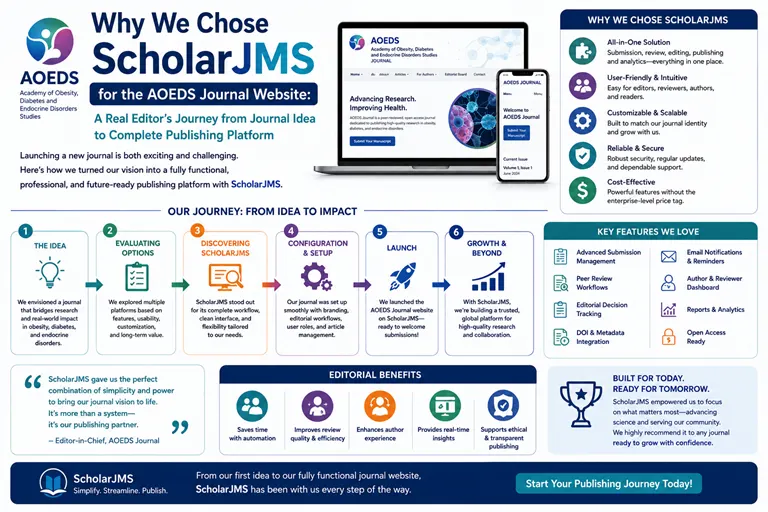
Why We Chose ScholarJMS for the AOEDS Journal Website: A Real Editor’s Journey from Journal Idea to Complete Publishing Platform
Introduction
When we first planned Advances in Obesity, Endocrinology, and Diabetes (AOEDS), we were not just thinking about creating a journal website. We were thinking about building a credible academic publishing platform that could support manuscript submissions, peer review, editorial decisions, article publishing, DOI assignment, indexing preparation, and long-term journal growth.
Like many journal founders, editors, research groups, and academic institutions, we started with a simple question:
How do you actually start a journal online in a professional way?
At first glance, the answer seems easy. Buy a domain, design a website, upload a few pages, and invite submissions. But when we started looking deeper, we realized that launching a serious scholarly journal requires much more than a website homepage.
A real academic journal needs:
● a proper journal website structure
● a manuscript submission and peer review system
● author, reviewer, and editor workflow
● article publication pages with metadata
● Crossref DOI readiness
● support for ISSN application and journal identity setup
● guidance for indexing and discoverability
● long-term technical support so the journal does not collapse after launch
That is the stage where we discovered that the most difficult part of launching a journal is not just publishing articles. It is choosing the right publishing technology partner.
After evaluating our needs, we finally chose ScholarJMS for the AOEDS journal website, with additional support from OJSCloud, GetDOI, and Scholar9. Looking back, this was one of the most important decisions for our journal’s digital foundation.
In this blog, I want to share why we chose ScholarJMS for AOEDS, what problems it solved for us, how it helped us move toward a more professional journal workflow, and why I believe editors who are searching “how to start a journal online” should seriously consider working with the same ecosystem if they want a practical one-stop solution for journal website development and management.
Table of Contents
- Why launching a journal is harder than it looks
- What we needed for AOEDS before launch
- Why we did not want a simple static journal website
- Why we chose ScholarJMS for AOEDS
- How OJSCloud supported us beyond just hosting
- How we got ISSN consulting support for our journal
- Why Crossref DOI support mattered from day one
- How GetDOI made DOI planning easier
- Why transparent peer review and research credibility matter
- How Scholar9 fits into the modern journal ecosystem
- Why this platform stack is ideal for new journal founders
- If you are planning to start a journal online, here is my honest advice as an editor
- Who should consider ScholarJMS and OJSCloud
- Why we now see this team as a one-stop journal solution provider
- Contact details for journal launch, ISSN, DOI, and website setup
- Frequently asked questions
- Conclusion
1. Why Launching a Journal Is Harder Than It Looks
Before AOEDS went live, we made one important discovery: a scholarly journal is not just a website, it is an operating system for academic publishing.
If your goal is to create a serious journal in medicine, health sciences, pharmacy, engineering, management, law, social sciences, or any other field, you quickly realize that you need to manage several moving parts at once:
● journal branding and website design
● aims and scope pages
● editorial board presentation
● author guidelines and ethics policies
● online manuscript submission
● reviewer invitation and peer review workflow
● editorial decision tracking
● issue and article publishing
● DOI assignment
● indexing preparation
● archive structure and metadata quality
● technical support for future growth
This is where many new journal founders get stuck. They may have strong academic intent, but they do not have the technical publishing infrastructure to support the journal properly.
That was exactly the challenge we wanted to avoid with AOEDS.
2. What We Needed for AOEDS Before Launch
When we planned AOEDS, we knew we needed something more serious than a basic journal website. Our expectations included both front-end journal presentation and back-end editorial workflow.
We wanted AOEDS to have:
● a professional journal homepage and article display structure
● a complete online manuscript submission system
● editor, reviewer, and author accounts
● article-wise publishing workflow
● clean issue and archive structure
● future-ready DOI integration
● metadata-oriented publishing architecture
● ability to grow into an indexed, trusted academic journal
● long-term technical support instead of one-time website delivery
We also wanted a solution that would help us not only launch the journal, but also operate it efficiently after launch.
That distinction is important.
A lot of vendors can build a journal website. Far fewer can support the actual publishing workflow behind a scholarly journal.
3. Why We Did Not Want a Simple Static Journal Website
One of the earliest decisions we made was that AOEDS should not be launched as a simple static website with a contact form and a list of PDFs.
That type of setup may look acceptable at first, but it becomes limiting very quickly.
A static journal website creates problems such as:
● no proper manuscript tracking
● no editor-reviewer-author workflow
● no structured article submission management
● no professional decision flow
● difficulty scaling when submissions increase
● fragmented email-based communication
● poor publishing discipline and weak audit trail
● extra manual work for editors
● reduced professionalism in front of authors and reviewers
For a serious journal, we wanted a system where the journal website and the journal management workflow were connected.
That requirement is one of the main reasons we moved toward ScholarJMS.
4. Why We Chose ScholarJMS for AOEDS
After reviewing our needs, we selected ScholarJMS because it gave us what we were actually looking for: a journal-focused publishing system, not just a generic website.
From the AOEDS editor’s perspective, these were the biggest reasons:
4.1 It gave us a real journal management workflow
AOEDS needed more than a web designer. We needed a system where:
● authors can submit manuscripts online
● editors can receive and manage submissions centrally
● reviewers can be invited and tracked
● decisions can move through a structured editorial flow
● accepted articles can move toward publication in an organized way
ScholarJMS offered that kind of environment.
4.2 It felt aligned with academic publishing, not generic CMS logic
Many general website tools can create pages, but academic journals need workflows built around:
● submission
● review
● revision
● acceptance
● production
● publication
● metadata consistency
ScholarJMS is built around journal publishing logic, which made it much more suitable for AOEDS than a generic website builder.
4.3 It supported a modern journal website structure
We wanted a site that looked current, professional, and suitable for a medical journal. ScholarJMS gave us a journal website structure that was designed around:
● journal identity
● issue and archive display
● article pages
● editorial information
● submission journey
● discoverability-oriented structure
4.4 It gave us confidence that the platform could grow with the journal
We were not launching AOEDS for a few months. We wanted to build it for long-term growth. That meant choosing a platform that could support:
● more submissions
● more issues
● more articles
● DOI-linked article publishing
● indexing readiness
● better editorial discipline over time
For us, ScholarJMS looked like a growth-oriented journal platform, not just a launch tool.
5. How OJSCloud Supported Us Beyond Just Hosting
One of the best parts of the AOEDS journey was that we did not have to assemble 10 different vendors for 10 different journal tasks. We received support through the broader ecosystem connected with OJSCloud.
Initially, some people think of OJSCloud only as an OJS-related service brand. But our experience showed that it can play a much broader role as a journal launch and publishing support partner.
For AOEDS, the value of OJSCloud was not limited to hosting
What stood out to us was the consulting and implementation support around the journal setup journey itself.
This included practical guidance around:
● journal website planning
● publishing structure
● ISSN-related consulting
● DOI readiness
● editorial setup support
● platform direction and migration decisions where needed
If you are a journal owner or editor who is not deeply technical, this kind of support matters a lot. It reduces confusion and prevents costly mistakes at the beginning.
6. How We Got ISSN Consulting Support for Our Journal
One of the most useful parts of our journey was receiving ISSN consulting support through OJSCloud.
Anyone searching “how to start a journal online” quickly learns that getting the website live is only one part of the process. A serious journal also needs to think about journal identity, title presentation, publishing scope, publishing frequency, and ISSN-related readiness.
For AOEDS, ISSN guidance was important because we wanted the journal to be structured properly from the beginning.
Starting a new journal and need ISSN, DOI, and journal website setup help?
Talk directly with our journal publishing support team.


Mr. Darshan Patel (ME-CE)
COO & Journal Publishing Technology Consultant
Sequence Research & Development Pvt. Ltd.
Ahmedabad | Gujarat | India
Email for Crossref Prefix: inquiry@ojscloud.com
WhatsApp Crossref DOI: +918200385143
www.ScholarJMS.com
Why ISSN consulting matters for new journals
Many new publishers do not know:
● when to apply for ISSN
● what website pages should be ready before applying
● how the journal title and scope should be presented
● what publishing details strengthen the journal’s application
● what supporting information may be needed during the process
This is where consulting support becomes valuable.
Our experience
Instead of trying to figure out the ISSN process alone, we were able to get guidance through OJSCloud, which saved time and reduced uncertainty.
If you are planning to launch a journal and want help with ISSN consulting, journal setup planning, and website readiness, I strongly suggest not delaying that discussion.
7. Why Crossref DOI Support Mattered from Day One
From the beginning, we wanted AOEDS to behave like a proper scholarly journal, not just a website that uploads PDFs.
That meant we wanted a structure that could support article-level DOI assignment and long-term discoverability. For modern journals, DOI planning should not be treated as an afterthought.
Why DOI matters for journals
A DOI helps strengthen article identity and citation reliability. For journals, DOI support matters because it contributes to:
● persistent article linking
● stronger publishing credibility
● easier citation and article tracking
● a more professional publication record
● better readiness for modern scholarly workflows
For a journal in obesity, endocrinology, and diabetes, we wanted article publishing to look credible and future-ready from the beginning.
That is why DOI support was part of our planning conversation early in the process.
8. How GetDOI Made DOI Planning Easier
For DOI-related support, the ecosystem around AOEDS included GetDOI.
This was important because many new journal founders know they need DOI, but they are not sure:
● how to obtain DOI support
● whether they need direct Crossref membership or a sponsor route
● how DOI assignment works for journal articles
● how many DOIs they may need
● how DOI workflow should fit into the journal publishing process
Why this matters for new journals
If DOI is handled late or in a fragmented way, the journal may end up with:
● inconsistent article metadata
● publishing delays
● confusion over article registration
● unnecessary operational complexity
A structured DOI support partner helps reduce that confusion.
For journals starting from scratch
If you are planning to launch a new journal, I would strongly recommend discussing DOI strategy early, not after publishing several issues. The combination of journal platform planning + DOI readiness is much stronger than trying to bolt DOI onto a weak workflow later.
9. Why Transparent Peer Review and Research Credibility Matter
As scholarly publishing evolves, journals are under growing pressure to demonstrate stronger peer review integrity, editorial transparency, and publication ethics confidence.
That is why we also paid attention to tools connected with transparent peer review and scholarly workflow visibility.
A journal today is judged not only by its articles, but also by how seriously it treats:
● peer review discipline
● editorial workflow
● research trust
● publication ethics
● author communication
● decision transparency
For an emerging journal, building this mindset early is important.
10. How Scholar9 Fits into the Modern Journal Ecosystem
This is where Scholar9 becomes relevant.
If your journal wants to move toward a more modern scholarly publishing environment, platforms like Scholar9 can add value by supporting a more transparent and research-oriented publishing ecosystem around peer review and journal credibility.
For a journal owner, the big lesson is this:
A journal should not be built only for today’s PDF uploads
It should be built for:
● future workflow maturity
● better review transparency
● stronger publication trust
● improved scholarly presentation
● long-term journal credibility
That is one of the reasons I appreciate the larger ecosystem around AOEDS. It is not just a website vendor arrangement. It is a broader publishing support environment.
11. Why This Platform Stack Is Ideal for New Journal Founders
Looking back, one of the biggest advantages for AOEDS was that we did not have to search separately for:
● a journal website developer
● a manuscript management system
● an ISSN consultant
● a DOI support provider
● a transparent peer review support direction
● long-term journal technical guidance
Instead, we could align with a connected ecosystem involving:
● ScholarJMS for journal website and manuscript workflow
● OJSCloud for journal launch support, OJS and publishing consulting, and ISSN guidance
● GetDOI for DOI support strategy
● Scholar9 for modern transparent peer review direction
Why this matters for new publishers
If you are a university, society, professor, hospital group, institute, NGO, or private publisher trying to start a journal, you need coordination, not confusion.
That is exactly why I believe this stack is useful. It reduces fragmentation.
12. If You Are Planning to Start a Journal Online, Here Is My Advice as an Editor
If I had to give one piece of advice to anyone searching “how to start an online journal”, it would be this:
Do not start by asking only how to build a website. Start by asking how to build a publishing system.
A real journal launch should think about all of these from day one:
● journal scope and academic identity
● ISSN planning
● website structure
● manuscript workflow
● editorial operations
● DOI readiness
● peer review management
● article publishing architecture
● future indexing preparedness
● long-term support partner
If you ignore these early, you may still launch a website, but you may not actually launch a strong journal.
13. Who Should Consider ScholarJMS and OJSCloud
Based on our AOEDS experience, I believe the ecosystem around ScholarJMS and OJSCloud is especially relevant for:
13.1 New journal founders
If you are starting a journal from zero and need end-to-end guidance.
13.2 Existing journals using email-only workflows
If your journal currently receives submissions manually and you want to move to a structured system.
13.3 OJS-based journals wanting modernization
If your journal is already on OJS but you want a more guided, modern, or better-supported workflow environment.
13.4 Medical, pharmacy, management, engineering, law, education, and multidisciplinary journals
If you want a professional journal platform without building everything from scratch.
13.5 Institutions planning multiple journals
If your university or organization wants a repeatable journal-launch framework rather than one-off website work every time.
14. Why We Now See This Team as a One-Stop Journal Solution Provider
From the AOEDS perspective, the biggest strength of working with this ecosystem is that it brings together the core parts of journal publishing under one broader umbrella.
In practical terms, that means support for:
● journal website planning
● journal management system setup
● online manuscript submission workflow
● issue and article publishing structure
● ISSN consulting support
● Crossref DOI support planning
● peer review and transparency ecosystem direction
● technical assistance for long-term journal operations
That is why I no longer think of this only as a software choice.
I see it as a journal infrastructure partnership.
And if someone asked me today, “Who can help me start a scholarly journal online from scratch with website, ISSN guidance, DOI support, and journal workflow setup?”, I would say that the combination of ScholarJMS, OJSCloud, GetDOI, and Scholar9 is one of the most practical one-stop options to evaluate.
Need a complete journal setup solution?
We can help with:
● Journal website development
● ScholarJMS setup
● OJS migration
● ISSN consulting
● Crossref DOI support
● journal workflow setup
Contact now:
Mr. Darshan Patel (ME-CE)
COO & Journal Publishing Technology Consultant
Sequence Research & Development Pvt. Ltd.
Ahmedabad | Gujarat | India
Email for Crossref Prefix: inquiry@ojscloud.com
WhatsApp Crossref DOI: +918200385143
www.ScholarJMS.com
15. Contact Details for Journal Launch, ISSN, DOI, and Website Setup
If you are planning to start a new academic journal, migrate an existing journal, obtain ISSN consulting, arrange Crossref DOI support, or build a complete journal website with manuscript management workflow, you can directly contact the team behind the ecosystem we used for AOEDS.
Journal Launch and Journal Website Support
● ScholarJMS: www.scholarjms.com
● OJS and Journal Consulting via OJSCloud: www.ojscloud.com
● Crossref DOI Support via GetDOI: www.getdoi.com
● Transparent Peer Review Ecosystem via Scholar9: www.scholar9.com
Direct Contact
● WhatsApp / Call: +91 82003 85143
● Email: inquiry@ojscloud.com
Best for queries related to:
● how to start a journal online
● journal website development
● ScholarJMS demo or migration
● OJS to ScholarJMS migration
● ISSN consulting for new journals
● Crossref DOI prefix support
● journal workflow setup
● medical journal website development
● academic publishing platform setup
16. Frequently Asked Questions
1. I want to start a journal online. What do I need first?
You need more than a website. A serious journal launch should consider journal scope, website structure, ISSN planning, manuscript submission workflow, peer review process, DOI readiness, and long-term editorial operations.
2. Why did AOEDS choose ScholarJMS instead of using only a static website?
Because AOEDS needed a real journal workflow system with submission, editorial handling, publishing structure, and long-term journal management capability, not just a brochure-style website.
3. Can OJSCloud help with ISSN consulting?
From our AOEDS experience, yes. ISSN-related consulting support was one of the useful parts of the broader journal setup process, especially for a new journal that needed guidance on readiness and structure.
4. What is the role of GetDOI in journal setup?
GetDOI helps journals think about Crossref DOI support and DOI workflow planning, which is important for article-level scholarly publishing.
5. Is this useful only for medical journals?
No. Although AOEDS is a journal in obesity, endocrinology, and diabetes, the same type of support can be valuable for journals in many disciplines including medicine, pharmacy, engineering, management, social sciences, law, education, and multidisciplinary research.
6. Can existing OJS journals migrate or modernize through this ecosystem?
Yes, this is especially relevant for journals that already have an OJS-based setup but want a more modern, guided, or integrated journal management environment.
17. Conclusion
Launching AOEDS taught us a very important lesson: building a journal is not about putting articles on a website. It is about creating a credible scholarly publishing system that can support editors, authors, reviewers, articles, metadata, DOI workflows, and long-term journal growth.
That is why we chose ScholarJMS as the journal management foundation for AOEDS, while also benefiting from the broader support ecosystem of OJSCloud, GetDOI, and Scholar9. Together, these services helped us think beyond a website and toward a more complete publishing framework involving journal setup, ISSN consulting, DOI planning, workflow structure, and future-ready editorial operations.
If you are currently searching online for how to start a journal website, how to launch an academic journal, how to get ISSN for a new journal, how to obtain Crossref DOI support, or which platform to choose for online journal publishing, my editor’s advice is simple:
Choose a partner that understands the full journal journey, not just the homepage design.
For us, that is exactly why the AOEDS journey moved toward ScholarJMS and its connected ecosystem. And if you are planning a new journal or upgrading an existing one, I believe it is worth having that conversation early.
Want to launch your own journal?
If you are planning a new journal or upgrading an existing one, you can directly contact:
Mr. Darshan Patel (ME-CE)
COO & Journal Publishing Technology Consultant
Sequence Research & Development Pvt. Ltd.
Ahmedabad | Gujarat | India
Email for Crossref Prefix: inquiry@ojscloud.com
WhatsApp Crossref DOI: +918200385143
www.ScholarJMS.com
For platform and service details, explore:
● OJSCloud
● GetDOI
● Scholar9