
What Is a Crossref DOI and Why Medical Journals Should Use It for Every Article
What Is a Crossref DOI and Why Medical Journals Should Use It for Every Article
Introduction
In modern scholarly publishing, a research article is not just a PDF uploaded to a website. It is a citable, discoverable, permanent scholarly record that should remain accessible over time, even if the journal website changes, the article moves to another server, or the publication platform is upgraded. This is where the DOI, or Digital Object Identifier, becomes essential.
For medical journals in particular, DOI assignment is no longer a luxury or an optional add-on. Journals publishing research in obesity, endocrinology, diabetes, metabolic disorders, thyroid disease, diabetic complications, and related clinical sciences need a stable and professional system for article identification, citation linking, and long-term visibility. A DOI helps ensure that every published article can be accurately referenced, easily located, and reliably connected to its metadata across scholarly systems.
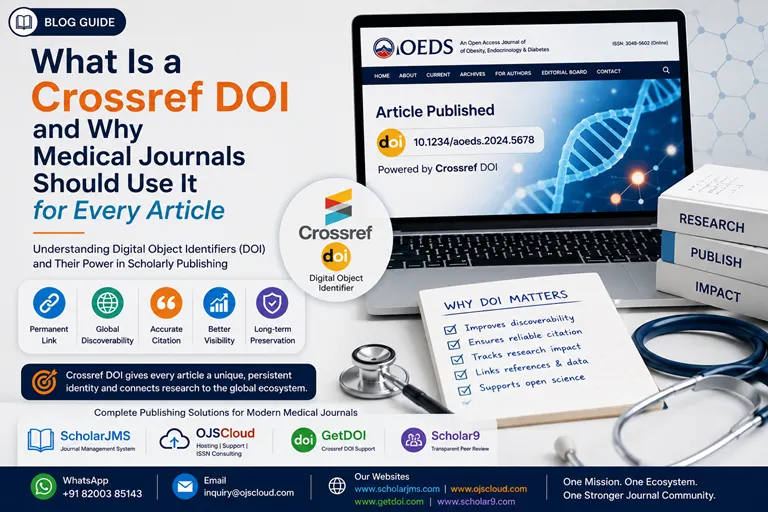
One of the most widely used DOI registration agencies in academic publishing is Crossref. Crossref DOI registration has become a standard practice among reputable journals because it supports persistent linking, better citation management, metadata distribution, and improved discoverability across the scholarly ecosystem.
In this article, we explain what a Crossref DOI is, how it works, why it matters for medical journals, and why every article in a journal should ideally have its own DOI. Whether you are a journal editor, publisher, society, institutional journal manager, or researcher trying to understand article DOI systems, this guide will give you a practical understanding of the subject.
Table of Contents
- What is a DOI?
- What does Crossref do in scholarly publishing?
- How is a Crossref DOI structured?
- DOI vs ordinary article URL: what is the difference?
- Why medical journals should assign DOI to every article
- How DOI improves citation, discoverability, and trust
- Which journal content should receive DOI?
- How Crossref DOI registration works for journals
- DOI, metadata, and journal professionalism
- Common misconceptions about DOI in journal publishing
- Practical checklist for journals planning DOI implementation
- Frequently asked questions
- Conclusion
1. What Is a DOI?
A DOI, or Digital Object Identifier, is a permanent digital identifier assigned to a piece of scholarly content such as a journal article, review paper, case report, editorial, dataset, conference paper, or book chapter. Its purpose is to provide a persistent, unique, and citable identity for that content.
https://getdoi.com/what-is-doi
Instead of depending only on a website URL, a DOI creates a stable reference that can continue to point users to the correct article location even if the journal changes its website structure, hosting server, or publishing platform.
For example, a medical journal article may have a DOI such as:
10.xxxx/aoeds.2025.001
This DOI acts like a long-term identity card for the article. When someone clicks or resolves the DOI, they are directed to the article landing page or current online location of the publication.
Why a DOI matters in simple terms
A DOI helps answer a very important question in scholarly communication:
If someone cites this article today, will future readers still be able to find it reliably years later?
A DOI makes that much more likely because it is designed to persist beyond normal website changes.
2. What Does Crossref Do in Scholarly Publishing?
Crossref is one of the most important organizations in scholarly publishing infrastructure. It is a DOI registration agency that helps journals, publishers, and other scholarly organizations register DOI for research outputs and deposit metadata connected with those outputs.
In practical terms, when a journal registers a DOI through Crossref, it is not just creating a code. It is also creating a structured metadata record that can include details such as:
● article title
● author names
● affiliations
● journal title
● volume and issue
● page numbers or article ID
● abstract
● publication date
● references
● URL of the article landing page
● ORCID information if available
This metadata becomes part of a larger scholarly network that supports citation linking, indexing, discovery, and long-term identification of published work.
Why Crossref is important for journals
Crossref helps journals do more than simply label an article. It supports:
● persistent article identification
● standardized metadata sharing
● reference linking across publications
● improved citation infrastructure
● integration with many scholarly discovery systems
● better professionalism and trust in publishing workflows
For a medical journal, this is especially valuable because article visibility and citation integrity matter not only for academic credit but also for clinical knowledge dissemination.
3. How Is a Crossref DOI Structured?
A DOI typically has two major parts:
1. Prefix
This is the part assigned through the DOI registration system and identifies the registrant or sponsoring structure.
Example:
10.xxxx
2. Suffix
This is the part created by the journal or publisher to identify a specific article or publication item.
Example:
aoeds.2025.001
When combined, the full DOI may look like:
10.xxxx/aoeds.2025.001
The exact DOI pattern varies from journal to journal, but the most important principle is that each DOI must be unique and consistently managed.
Good DOI design practices for journals
A journal should keep DOI structure:
● consistent across articles
● easy to manage internally
● unique for each publication item
● aligned with journal naming or article numbering where possible
For example, a journal may incorporate:
● journal abbreviation
● year
● article number
● issue or volume reference if desired
The exact DOI syntax is less important than its consistency and uniqueness.
4. DOI vs Ordinary Article URL: What Is the Difference?
This is one of the most common questions asked by journal owners and editors.
An ordinary URL
A normal URL points to a webpage location, such as a specific article page on a journal website. If the website structure changes, the article folder changes, or the journal migrates to a new platform, that URL may break unless it is manually redirected.
A DOI
A DOI is a persistent identifier, not just a web address. It points to the current registered location of the article. If the journal moves the article to a new page or a new platform, the DOI can still work as long as the DOI metadata is updated with the new URL.
Why this matters for journals
Imagine a journal that starts on one platform and later migrates to another. If articles only have ordinary URLs, older citations may break or become difficult to trace. But if each article has a DOI, the publisher can update the DOI destination and preserve continuity.
This is especially important for journals that:
● rebrand or redesign their website
● migrate from one journal platform to another
● change domain or hosting structure
● want long-term citation reliability
For medical journals, where published evidence may be cited in future reviews, guidelines, theses, and clinical discussions, broken access pathways are a serious problem. DOI helps reduce that risk.
5. Why Medical Journals Should Assign DOI to Every Article
Medical journals handle content that can influence clinical understanding, treatment discussions, academic progression, and future research. Because of this, every article deserves a stable and professional publishing identity.
Key reasons every article should have a DOI
1. DOI gives the article a permanent scholarly identity
A paper on obesity pharmacotherapy, diabetic nephropathy, thyroid dysfunction, or endocrine case management should not be treated as a temporary webpage. It should be treated as a permanent part of the scholarly record.
2. DOI improves citation quality
When authors cite an article with a DOI, the citation becomes more robust and traceable. Readers can find the paper more easily, and the article is better integrated into scholarly systems.
3. DOI supports journal credibility
A journal that assigns DOI to each article signals professionalism, commitment to publication standards, and long-term management of its content.
4. DOI supports discoverability
Well-deposited DOI metadata can help article visibility in scholarly environments where metadata is harvested, matched, or linked.
5. DOI helps during platform migration or website changes
If a journal moves from one website structure to another, DOI continuity can protect the accessibility of previously published articles.
6. DOI benefits all article types, not just original research
Review articles, case reports, editorials, short communications, and conference-linked publications can all benefit from DOI assignment.
In a field like obesity, endocrinology, and diabetes, where research is frequently cited and clinically relevant, DOI should be considered a standard publishing practice rather than an optional feature.
6. How DOI Improves Citation, Discoverability, and Trust
DOI and citation reliability
When an article includes a DOI, other researchers can cite it in a more stable way. Many citation styles and reference managers recognize DOI as a preferred identifier because it remains associated with the article even if the webpage changes.
DOI and discoverability
DOI alone does not magically guarantee indexing, but it significantly strengthens the discoverability framework when combined with quality metadata, article landing pages, abstracts, and structured references.
For example, when a journal deposits DOI metadata properly, the article is more likely to be linked and identified consistently across scholarly systems. This becomes especially important for:
● citation tracking
● database linking
● reference verification
● article sharing in academic environments
DOI and reader trust
Readers, librarians, editors, and researchers often see DOI as a sign that the article has been published through a more formal scholarly workflow. While DOI does not prove article quality by itself, it does contribute to the professional presentation and traceability of the publication.
For a specialty journal in obesity, endocrinology, and diabetes, trust is an important part of attracting authors and readers. DOI helps support that trust infrastructure.
7. Which Journal Content Should Receive DOI?
Some journals assign DOI only to selected article types, but the stronger and more professional approach is to assign DOI to every formal scholarly item that the journal publishes.
Content types that should ideally receive DOI
● original research articles
● review articles
● case reports
● editorials
● short communications
● letters if treated as formal publications
● conference-linked special issue articles
● corrigenda or errata if formally published
● supplementary scholarly outputs where appropriate
Why consistency matters
If one issue of a journal has DOI for some articles and another issue does not, it creates inconsistency in citation practice and metadata quality. It is much better to adopt a clear journal policy that every published article receives DOI.
For a journal like Advances in Obesity, Endocrinology, and Diabetes, assigning DOI consistently across all publishable article types strengthens the journal’s long-term scholarly identity.
8. How Crossref DOI Registration Works for Journals
While the technical workflow may vary slightly depending on the publishing platform or service arrangement, the basic process is usually straightforward.
https://scholar9.com/blog/crossref-doi-sponsorship-services
Step 1: The journal obtains DOI registration access
A journal can register DOI through an appropriate Crossref-related arrangement, depending on its publishing setup and membership pathway.
Step 2: Each article is prepared with essential metadata
Before DOI registration, the journal should have the article details ready, such as:
● article title
● author details
● journal name
● volume, issue, year
● abstract
● article landing page URL
● references if available
Step 3: A unique DOI is assigned to the article
The journal creates a DOI suffix according to its DOI naming policy and links it to the article metadata.
Step 4: Metadata is deposited
The article metadata, DOI, and landing page information are deposited into the DOI registration workflow.
Step 5: The DOI resolves to the article page
Once registered and active, the DOI should take readers to the article landing page on the journal website.
Step 6: DOI destination should be updated if the article URL changes
If the journal later changes its website structure or migrates platforms, the DOI record should be updated to reflect the new article location.
This is one reason journals should treat DOI registration as part of a managed publishing workflow rather than a one-time technical action.
Need Help with Crossref DOI for Your Medical Journal?
If your journal is planning to start Crossref DOI registration, obtain a DOI prefix through sponsorship, or streamline article-level DOI assignment for original articles, review papers, case reports, and editorials, it is often helpful to work with a reliable DOI support partner who understands journal workflows, metadata requirements, and article publishing structure.
https://scholar9.com/blog/how-to-get-a-crossref-doi-prefix-for-your-journal
For direct assistance with Crossref DOI support for journals, you may contact our support team here:


Mr. Darshan Patel (ME-CE)
COO & Journal Publishing Technology Consultant
Sequence Research & Development Pvt. Ltd.
Ahmedabad | Gujarat | India
Email for Crossref Prefix: inquiry@ojscloud.com
WhatsApp Crossref DOI: +918200385143
www.ScholarJMS.com
Our team can assist journals with DOI-related guidance such as Crossref DOI prefix support, article DOI setup, metadata deposit workflow guidance, and journal DOI implementation planning.
9. DOI, Metadata, and Journal Professionalism
A journal’s professionalism is not defined only by its logo, design, or subject matter. It is also reflected in the quality of its publishing infrastructure.
What professional journal publishing looks like
A professionally managed medical journal typically aims to provide:
● article-level DOI
● stable article landing pages
● clear citation information
● structured author and affiliation metadata
● consistent volume and issue records
● accessible archives
● proper publication dates
● transparent editorial workflow
DOI is a central part of this ecosystem because it connects article identity with metadata and long-term accessibility.
Why this matters for authors
Authors want confidence that their work will remain accessible and citable after publication. A journal that uses DOI properly sends a strong signal that the article will be treated as a durable scholarly output rather than a temporary web upload.
Why this matters for journal owners and editorial teams
For editorial offices, DOI-supported workflows improve record keeping, article traceability, and professional presentation. When combined with a well-structured journal platform, DOI becomes part of a stronger end-to-end publishing system.
10. Common Misconceptions About DOI in Journal Publishing
Misconception 1: “If my article has a URL, I do not need DOI.”
A URL and a DOI are not the same thing. A URL is just a location. A DOI is a persistent scholarly identifier linked with metadata and long-term reference use.
Misconception 2: “Only big international journals need DOI.”
Even a small or newly launched medical journal benefits from DOI because it improves citation quality, professionalism, and long-term accessibility from the beginning.
Misconception 3: “DOI automatically means the journal is indexed everywhere.”
DOI helps support discoverability and metadata quality, but it does not guarantee inclusion in every database. Good editorial standards, article quality, technical consistency, and indexing eligibility still matter.
Misconception 4: “Only original articles need DOI.”
Review articles, case reports, editorials, and other formal scholarly content also deserve DOI if they are part of the journal’s published record.
Misconception 5: “Once DOI is created, there is nothing else to manage.”
If article URLs change because of website migration or restructuring, DOI records may need to be updated. DOI is part of an ongoing publishing workflow.
11. Practical Checklist for Journals Planning DOI Implementation
If your journal is planning to start DOI assignment or improve an existing DOI workflow, review the following checklist.
Editorial and publishing checklist
● Does the journal assign DOI to every article consistently?
● Does each article have its own landing page?
● Are article titles, author names, abstracts, and references properly organized?
● Is there a clear DOI naming pattern for the journal?
● Are volume, issue, year, and article identifiers consistent?
● Is the DOI displayed clearly on the article page and PDF where appropriate?
● Is the journal maintaining accurate article metadata?
● If the website changes in future, is there a process to update DOI destination URLs?
● Are editorial staff aware of DOI-related publishing workflows?
● Does the journal treat DOI as part of long-term scholarly infrastructure rather than just a decorative label?
Technical and platform considerations
A journal should ideally use a publishing workflow that supports:
● article-level metadata organization
● stable article landing pages
● DOI integration or DOI-ready publishing practice
● efficient issue management
● clean archival structure
● easy update of article records when needed
For journals that want to scale professionally, DOI should be integrated into the journal’s overall publication management strategy rather than handled in isolation.
If your journal needs practical guidance on Crossref DOI setup, DOI workflow planning, DOI prefix support, or article-level DOI implementation, you may reach our support team directly:
WhatsApp: +91 82003 85143
Email: inquiry@ojscloud.com
12. Frequently Asked Questions
1. What is the full form of DOI?
DOI stands for Digital Object Identifier.
2. What is a Crossref DOI?
A Crossref DOI is a DOI registered through Crossref, a major scholarly infrastructure organization that supports DOI registration and metadata services for academic publications.
3. Why should a medical journal assign DOI to every article?
Because DOI improves article permanence, citation reliability, scholarly professionalism, discoverability support, and long-term access continuity.
4. Can a journal assign DOI to review articles and case reports?
Yes. DOI should ideally be assigned to all formal scholarly outputs published by the journal, including review articles, case reports, editorials, and original research papers.
5. Does DOI help if the journal changes its website?
Yes. One of the major advantages of DOI is that the DOI record can continue pointing to the correct article location if the journal updates the DOI destination after a platform or URL change.
6. Is DOI the same as indexing?
No. DOI and indexing are not the same. DOI helps create strong article identity and metadata infrastructure, but it does not automatically guarantee inclusion in all indexing databases.
13. Conclusion
A Crossref DOI is far more than a technical code attached to a journal article. It is a core component of modern scholarly publishing. For medical journals, especially those publishing in obesity, endocrinology, diabetes, thyroid disorders, metabolic medicine, and related clinical sciences, DOI plays a critical role in article permanence, citation quality, discoverability, and professional presentation.
An article without DOI may still exist online, but it lacks an important layer of long-term scholarly identity. By contrast, a journal that assigns DOI consistently to every article demonstrates that it values durable access, structured metadata, citation integrity, and modern publishing standards.
For editors, publishers, and journal owners, the message is simple: DOI should not be treated as an optional extra for selected papers. It should be part of the journal’s standard publication workflow for every formal article. Whether the content is an original research paper, review article, case report, or editorial, DOI helps preserve its place in the scholarly record.
In a specialty journal environment such as Advances in Obesity, Endocrinology, and Diabetes (AOEDS), where research may contribute to future clinical understanding, policy, treatment decisions, and academic discourse, article permanence and citation reliability are essential. Crossref DOI is one of the most practical and important tools for achieving that goal.