

OJS vs ScholarJMS: Which Journal Management Platform Is Better for New Academic Journals?
OJS vs ScholarJMS: Which Journal Management Platform Is Better for New Academic Journals?
Introduction
One of the most important decisions a journal founder, editor, university, society, or academic publisher will make is which platform to use for the journal website and manuscript workflow. In the early planning stage, this decision often feels technical. But in reality, it is much bigger than that. The platform you choose affects how authors submit papers, how reviewers are managed, how editors handle decisions, how articles are published, how scalable the journal becomes, and how professional the journal appears to authors and institutions.
For many years, Open Journal Systems (OJS) has been one of the most widely known names in journal publishing. Because of its long presence in scholarly publishing, many new journals naturally start by asking whether they should use OJS. At the same time, a growing number of journals are also exploring newer, more managed, and more service-oriented journal platforms such as ScholarJMS.
That creates a very practical question:
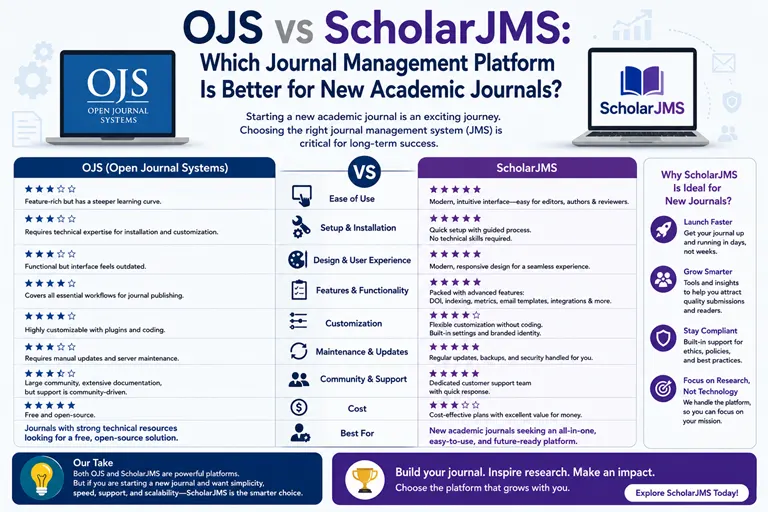
OJS vs ScholarJMS: which one is better for a new academic journal?
The answer depends on what kind of journal you are building, how much technical control you want, how much internal staff support you have, whether you want to manage hosting and system operations yourself, how important ease of use is for your editors, and whether you want a do-it-yourself journal software setup or a more guided journal publishing ecosystem.
This comparison is especially important for:
● universities planning a new institutional journal
● medical, pharmacy, management, law, education, engineering, or multidisciplinary journals launching from scratch
● existing journals currently using email-based submission and looking for a proper manuscript system
● OJS journals considering modernization or migration
● editors who want ISSN consulting, DOI support, and journal setup help alongside the platform itself
In this blog, I will compare OJS and ScholarJMS from the perspective of a journal founder or editor, not just a software developer. I will focus on the real questions journals ask:
● Which one is easier to launch with?
● Which one is better for manuscript workflow?
● Which one feels more manageable for a non-technical editorial team?
● Which one is better if you want help with ISSN consulting, DOI support, migration, and journal growth?
● Which one makes sense for a new journal in 2026?
Table of Contents
- Why this comparison matters for new journals
- What OJS is and why so many journals know it
- What ScholarJMS is and why it is gaining attention
- OJS vs ScholarJMS: the difference in overall approach
- Ease of setup for a new journal
- Website presentation and journal-facing design experience
- Manuscript submission and editorial workflow experience
- Technical dependency and day-to-day management burden
- OJS vs ScholarJMS for non-technical editors and institutions
- DOI, ISSN, and publishing-readiness considerations
- OJS migration: when journals start looking for an alternative
- Why a connected ecosystem matters more than software alone
- When OJS may still make sense
- When ScholarJMS is likely the better choice
- My recommendation for new journals in 2026
- Direct support for journal setup, migration, ISSN, and DOI
- Frequently asked questions
- Conclusion
1. Why This Comparison Matters for New Journals
A journal platform is not just a technical tool. It becomes the operating backbone of the journal.
The platform influences:
● how the journal looks to authors and readers
● how easily submissions are handled
● how reviewers are invited and tracked
● how editors manage decisions and revisions
● how article archives are published
● how well the journal can grow in the future
● how much manual work the editorial office has to do
If the platform is too difficult, too fragmented, too dependent on technical intervention, or too poorly aligned with the journal’s actual workflow, the journal may struggle even if the editorial board is academically strong.
This is why choosing between OJS and ScholarJMS is not just a software preference. It is a publishing strategy decision.
2. What OJS Is and Why So Many Journals Know It
OJS, or Open Journal Systems, is one of the most recognized names in the academic journal publishing world. Many journals, especially institutional and university-led journals, have used OJS because it offers a framework for online journal publishing, manuscript handling, and issue management.
Why OJS became popular
OJS became widely used because it offered journals a structured way to:
● create an online journal website
● manage article submissions
● handle editorial and review workflows
● publish issues and archives
● operate within a journal-oriented software environment rather than a generic website builder
For many institutions, especially those looking for an open-source journal system, OJS has historically been an obvious option.
Why OJS is still relevant
Even today, many journals continue to use OJS because:
● they are already familiar with it
● their institution adopted it years ago
● their editorial workflow has been built around it
● they have in-house technical support or a vendor supporting their OJS environment
So this comparison is not about dismissing OJS. It is about asking whether it is still the best fit for new journals launching now, especially those that want faster setup, smoother support, less technical burden, and a more guided ecosystem.
3. What ScholarJMS Is and Why It Is Gaining Attention
ScholarJMS is a journal-focused publishing platform designed to support journal website setup, manuscript submission, editorial workflow, and long-term publishing operations in a more managed and service-oriented way.
For many journal founders, the appeal of ScholarJMS is not only that it provides a journal management environment, but that it often comes with a broader support ecosystem rather than leaving the journal to manage everything independently.
Why journals are looking at ScholarJMS
Many journals today want:
● a modern journal website and workflow environment
● a system that is easier for editors and staff to handle
● reduced dependence on technical intervention for routine journal work
● support with journal setup, migration, DOI planning, and ISSN-related readiness
● a platform that feels like a journal publishing solution, not just software installation
This is where ScholarJMS becomes attractive, especially when supported alongside:
● OJSCloud for OJS support, migration, journal launch consulting, and ISSN consulting
● GetDOI for Crossref DOI support
● Scholar9 for transparent peer review and research-trust direction
4. OJS vs ScholarJMS: The Difference in Overall Approach
Before comparing features, it is important to understand the broader difference in philosophy.
OJS often feels like a software framework you implement and manage
In many cases, OJS is a platform that gives you the infrastructure, but you still need to think about:
● hosting
● setup
● theme / design configuration
● updates
● plugin compatibility
● technical troubleshooting
● workflow adjustments
● operational support
Depending on your setup, you may manage some of this yourself or through a service provider.
ScholarJMS feels more like a managed journal publishing environment
ScholarJMS is attractive to journals that do not want to think only in terms of software installation. Instead, they want:
● a ready journal workflow environment
● guided setup
● a more supported publishing structure
● less technical friction for the editorial team
● connected support for related needs like ISSN, DOI, migration, and journal website planning
In simple terms
● OJS can be powerful, but often requires more platform-management mindset
● ScholarJMS is attractive when you want a journal operations mindset with more direct support
This distinction is extremely important for new journals.
5. Ease of Setup for a New Journal
For a new journal, the launch phase is often chaotic enough already. The editorial board is being assembled, the journal title is being finalized, author guidelines are being written, and ISSN / DOI discussions are beginning. The last thing many editors want is a platform setup journey that adds more complexity.
OJS setup reality
OJS can certainly be launched successfully, but for many new journals it may involve:
● selecting hosting or managed hosting
● configuring the platform
● choosing or customizing a theme
● setting up workflows carefully
● handling plugin or integration questions
● relying on technical support for configuration or troubleshooting
This is not necessarily a problem if the institution has a strong technical publishing team. But many new journals do not.
ScholarJMS setup advantage
For new journals that want a more direct route, ScholarJMS can feel easier because the conversation is not only “install software” but “let’s set up your journal properly.”
That difference matters. A journal founder often needs help with:
● website structure
● manuscript workflow
● archive planning
● editorial role setup
● DOI readiness discussion
● ISSN readiness planning
● migration planning if the journal already exists elsewhere
This is why new journals often find ScholarJMS more approachable than a purely self-managed or semi-managed platform route.
6. Website Presentation and Journal-Facing Design Experience
A journal website should not feel like an afterthought. It is the journal’s public face. Authors judge credibility by it. Reviewers judge seriousness by it. Indexing reviewers may eventually assess professionalism partly through it.
What journals often want from the front-end
● clean homepage
● clear journal identity
● well-structured editorial pages
● article and archive pages that feel professional
● easy navigation for authors and readers
● a current and trustworthy visual experience
OJS experience
OJS can certainly power a journal website, but the final experience often depends on:
● the theme being used
● how well it has been configured
● whether the site has been customized properly
● how much design attention the journal or vendor has invested
ScholarJMS experience
ScholarJMS is appealing to journals that want a more polished journal-first presentation without having to piece together multiple design and workflow decisions separately.
For new journals, this matters because a professional website helps immediately with:
● author trust
● institutional confidence
● editorial pride
● submission conversion
7. Manuscript Submission and Editorial Workflow Experience
This is one of the most important parts of the comparison.
A journal platform is not judged only by how the homepage looks. It is judged by what happens after the manuscript arrives.
A good journal workflow should make it easy to:
● receive submissions
● assign editors
● invite reviewers
● track reviewer responses
● manage revisions
● record editorial decisions
● move accepted papers toward publication
● keep the journal office organized
OJS workflow perspective
OJS does provide journal workflow structure and has long been used for editorial handling. However, the experience can vary depending on:
● how the workflow is configured
● how comfortable editors are with the interface
● whether the journal has internal staff familiar with OJS operations
● whether support is available when the editorial office gets stuck
ScholarJMS workflow perspective
ScholarJMS becomes especially attractive when the editorial office wants a workflow that feels easier to adopt, more guided, and more aligned with day-to-day journal operations rather than software administration.
This is especially relevant for:
● small editorial offices
● new journals with limited staff
● editors who are academics first and system administrators second
● institutions that want their journal team to focus on publishing rather than troubleshooting
8. Technical Dependency and Day-to-Day Management Burden
This is the section where many journals realize the real difference between platforms.
With OJS, the journal may still need to think about:
● updates
● theme adjustments
● plugin compatibility
● hosting concerns
● troubleshooting technical issues
● version-related support
● configuration tasks
If the journal has a strong internal technical team or a dedicated OJS service partner, this may be manageable. But for many journals, it becomes an ongoing burden.
With ScholarJMS, the attraction is reduced operational friction
A journal founder often does not want to spend time asking:
● who will fix the workflow issue?
● who will update the system?
● who will adjust the journal structure?
● who will help with migration?
● who will guide DOI or ISSN-related publishing setup questions?
The more those concerns are handled within a managed support ecosystem, the easier it becomes for the editorial office to focus on the journal itself.
9. OJS vs ScholarJMS for Non-Technical Editors and Institutions
This is probably the most practical question in the whole comparison:
Which platform is better if the journal team is not highly technical?
For many institutions, the editor-in-chief is a professor, researcher, or clinician, not a platform engineer. The same is true for managing editors, section editors, and editorial assistants.
In that environment, the ideal platform should:
● feel intuitive
● reduce unnecessary technical dependency
● make the editorial workflow manageable
● provide responsive support when needed
● help with the broader journal launch journey, not only software screens
My view
If the journal has:
● no strong in-house technical publishing team
● limited OJS experience
● a need for guided launch support
● ISSN and DOI questions
● interest in migration or modernization
● a desire for a more complete journal publishing partner
then ScholarJMS is usually the more practical choice.
10. DOI, ISSN, and Publishing-Readiness Considerations
A journal platform should not be evaluated only by manuscript workflow. It should also be evaluated by how well it fits into the larger publishing journey.
A new journal typically needs to think about:
● ISSN consulting and readiness
● DOI support planning
● article-level metadata discipline
● journal structure that supports discoverability
● policies and publishing architecture that feel credible
This is where the ecosystem around the platform matters
With a connected support structure, the journal can discuss:
● ISSN consulting through OJSCloud
● Crossref DOI support through GetDOI
● workflow and platform setup through ScholarJMS
● transparent peer review direction through Scholar9
Why this is a major advantage
When a journal compares OJS and ScholarJMS, it should not ask only:
● Which platform has screens for submission?
It should also ask:
● Which ecosystem can help me launch and grow the journal properly?
That is where ScholarJMS gains a very strong practical advantage.
Need help choosing between OJS and ScholarJMS?
If you are planning a new journal, or already have an OJS journal and want to evaluate whether migration to ScholarJMS makes sense, you can directly discuss your case with us.
We can help with:
● OJS vs ScholarJMS platform guidance
● New journal website setup
● OJS to ScholarJMS migration
● ISSN consulting
● Crossref DOI support planning
● journal workflow modernization
Contact us directly
● WhatsApp: +91 82003 85143
● Email: inquiry@ojscloud.com
11. OJS Migration: When Journals Start Looking for an Alternative
A lot of journals do not ask “OJS vs ScholarJMS” at the beginning. They ask it later, after they have already been using OJS for some time.
Why journals start considering migration
Common reasons include:
● the editorial team wants a more guided or simpler workflow environment
● the journal wants a more modern presentation
● technical maintenance feels heavy
● the institution wants stronger support
● the journal wants a better long-term operational experience
● the current OJS setup is functional but not comfortable
● the journal wants a platform partner rather than only a software environment
When migration becomes worth evaluating
Migration becomes worth serious discussion when the journal feels that:
● too much time is going into system management rather than publishing
● the editorial team is not comfortable with the current workflow
● the journal wants modernization without rebuilding everything from scratch
● the publisher wants a one-stop support structure for website, DOI, ISSN, and workflow
This is where OJSCloud becomes particularly useful because it can support both OJS-side understanding and migration-related consulting toward ScholarJMS.
12. Why a Connected Ecosystem Matters More Than Software Alone
This is, in my opinion, the most important insight for journal founders.
Most journal owners are not actually looking for software in isolation. They are looking for a publishing solution.
That solution often needs to include:
● journal website setup
● manuscript management system
● workflow guidance
● ISSN consulting
● DOI support
● article publishing structure
● migration help if the journal already exists
● long-term operational support
This is why the combined ecosystem matters
The practical strength of the ScholarJMS side is not only the platform itself, but the fact that it can sit inside a broader support structure involving:
● ScholarJMS for journal management and website workflow
● OJSCloud for journal launch support, OJS support, migration guidance, and ISSN consulting
● GetDOI for Crossref DOI planning and support
● Scholar9 for transparent peer review direction and research-trust alignment
Why this matters in the real world
If you are starting a journal, you do not want to chase five different providers for five different problems. A connected ecosystem reduces that friction dramatically.
13. When OJS May Still Make Sense
To keep this comparison fair, there are definitely cases where OJS may still be a sensible choice.
OJS may still make sense if:
● your institution already has a stable OJS environment
● you have an internal technical team comfortable managing OJS
● your editorial office is already trained on OJS and satisfied with it
● you do not mind a more hands-on platform-management approach
● your workflows are already deeply integrated into an OJS-based process
In these cases, staying with OJS may be perfectly reasonable.
This is why I do not frame the comparison as “OJS is bad.”
The better framing is:
Is OJS still the best operational fit for your journal today?
That answer will vary by journal.
14. When ScholarJMS Is Likely the Better Choice
In my view, ScholarJMS is usually the stronger choice when the journal wants practical publishing support, not just software access.
ScholarJMS is especially attractive when:
● you are launching a new journal from scratch
● your editorial team is not highly technical
● you want a modern journal website + manuscript workflow together
● you want help with ISSN consulting and DOI planning
● you want a one-stop ecosystem rather than separate vendors
● you are currently on OJS but want a more guided environment
● you want to focus on running the journal, not managing the platform
● you want migration help and journal-launch consulting from the same broader team
For many new journals in medicine, pharmacy, management, law, engineering, education, and multidisciplinary research, these points make ScholarJMS very compelling.
15. My Recommendation for New Journals in 2026
If a university, editor, medical society, research institute, or academic entrepreneur asked me:
“We are starting a new journal in 2026. Should we use OJS or ScholarJMS?”
my answer would usually be:
Choose ScholarJMS if you want a more complete, guided, and growth-oriented journal publishing solution.
Why?
Because most new journals do not simply need software. They need:
● launch guidance
● website structure
● manuscript workflow
● ISSN consulting direction
● DOI planning
● migration flexibility
● long-term support
● less technical friction for the editorial team
That combination is where ScholarJMS + OJSCloud + GetDOI + Scholar9 becomes far more attractive than a purely software-centric decision.
If, however, the journal already has a strong OJS environment, internal expertise, and no pain with the current system, then OJS can still remain a valid choice.
But for new journals building fresh, I would lean strongly toward ScholarJMS.
16. Direct Support for Journal Setup, Migration, ISSN, and DOI
If you are trying to decide between OJS and ScholarJMS, or you are planning to launch a new journal and want a one-stop publishing setup, you can directly contact us.
We can help with:
● New journal website setup
● ScholarJMS onboarding
● OJS to ScholarJMS migration
● OJS consulting and support
● ISSN consulting for new journals
● Crossref DOI support planning
● journal workflow modernization
● editorial system setup for medical, pharmacy, engineering, management, law, education, and multidisciplinary journals
Explore our platforms
● Journal Management Platform: ScholarJMS
● OJS Support, Migration, and ISSN Consulting: OJSCloud
● Crossref DOI Support: GetDOI
● Transparent Peer Review Ecosystem: Scholar9
Contact Now
● WhatsApp: +91 82003 85143
● Email: inquiry@ojscloud.com
17. Frequently Asked Questions
1. Is ScholarJMS an alternative to OJS?
Yes. For many journals, ScholarJMS can function as a practical alternative to OJS, especially when the journal wants a more managed, guided, and service-oriented publishing environment.
2. Is OJS bad for journals?
No. OJS has played an important role in scholarly publishing and still works well for many institutions. The real question is whether it remains the best operational fit for your journal’s current needs.
3. Why do some journals migrate from OJS to ScholarJMS?
Common reasons include the desire for a more modern workflow experience, reduced technical burden, easier support, migration guidance, and a more complete publishing ecosystem that includes ISSN and DOI-related help.
4. Which platform is better for a non-technical editorial office?
In most cases, a non-technical editorial office will find ScholarJMS easier and more practical, especially when supported alongside OJSCloud, GetDOI, and Scholar9.
5. Can I get ISSN consulting and DOI help along with the journal platform?
Yes. That is one of the key advantages of the broader ecosystem:
● OJSCloud for ISSN consulting and journal support
● GetDOI for DOI support
● ScholarJMS for journal platform setup
● Scholar9 for transparent peer review direction
6. How do I know if my journal should stay on OJS or migrate?
The best way is to review:
● how comfortable your editorial team is with OJS
● how much technical support you have
● whether the current workflow is slowing you down
● whether you want a more managed journal solution
● whether you need help with modernization, DOI, ISSN, or migration planning
18. Conclusion
The question “OJS vs ScholarJMS” is really a question about what kind of journal publishing experience you want.
If your journal is comfortable with a more traditional software-framework approach, already has stable OJS infrastructure, and has the technical capacity to manage that environment well, then OJS can still be a valid and useful option.
But if you are a new journal founder, a non-technical editorial team, an institution planning a fresh journal launch, or an existing OJS journal looking for a more guided and modern publishing environment, then ScholarJMS is likely to be the stronger choice.
That is because the decision should not be based only on software screens. It should be based on the full journal journey:
● how easily the journal launches
● how comfortably the editorial team operates it
● whether the journal can get support with ISSN and DOI planning
● how migration or modernization can be handled
● whether the platform sits inside a larger publishing ecosystem that actually understands journals
For that reason, I believe the combination of:
● OJSCloud
● GetDOI
● Scholar9
offers one of the most practical one-stop routes for journals that want website setup, manuscript workflow, ISSN consulting, Crossref DOI support, migration guidance, and long-term publishing assistance under a connected ecosystem.
Want help choosing or migrating your journal platform?
If you are starting a journal or evaluating migration from OJS to ScholarJMS, feel free to contact us directly:
● WhatsApp: +91 82003 85143
● Email: inquiry@ojscloud.com
Recommended CTA placements inside this blog
Because this is a high-conversion comparison blog, I strongly recommend adding two CTA blocks inside the article body.
CTA Block 1
Place after Section 10: DOI, ISSN, and Publishing-Readiness Considerations
Confused between OJS and ScholarJMS for your journal?
We can help you evaluate the right path for:
● new journal launch
● OJS to ScholarJMS migration
● ISSN consulting
● Crossref DOI support
● journal workflow modernization
WhatsApp: +91 82003 85143
Email: inquiry@ojscloud.com
CTA Block 2
Place after Section 16: Direct Support for Journal Setup, Migration, ISSN, and DOI
Looking for a one-stop journal publishing solution?
Explore:
● OJSCloud
● GetDOI
● Scholar9
Talk directly with our team:
WhatsApp: +91 82003 85143
Email: inquiry@ojscloud.com
My recommendation for the next blog
Now the most logical next one is:
Blog C
How to Get ISSN and Crossref DOI for a New Journal: A Practical Guide for Editors and Publishers
This one will be very strong because it will capture people searching:
● how to get ISSN for a journal
● how to get e-ISSN
● how to get Crossref DOI prefix
● ISSN vs DOI for journals
● how to start a journal with DOI
● ISSN consulting services
And it will give you a very strong lead path toward OJSCloud + GetDOI.
If you want, just say “continue Blog C” and I’ll draft it fully in the same style.