


OJS vs Modern Journal Management Systems for Medical Journals: Which Is Better for Editors and Publishers?
OJS vs Modern Journal Management Systems for Medical Journals: Which Is Better for Editors and Publishers?
Introduction
Launching or managing a medical journal today involves much more than publishing PDF files online. Journals must handle author submissions, editorial screening, reviewer invitations, peer review, revisions, copyediting, issue management, article publication, DOI integration, metadata handling, and long-term archiving. For journals working in fast-moving fields such as obesity, endocrinology, diabetes, metabolic medicine, thyroid disorders, and related clinical sciences, a smooth and reliable publishing workflow is essential.
One of the most widely used platforms in academic publishing is Open Journal Systems (OJS). OJS has helped thousands of journals around the world establish online submission and editorial workflows. It is well known in scholarly publishing and remains an important platform for many journals, societies, and institutions. At the same time, the publishing landscape has evolved. Many editorial teams today are looking for more streamlined, managed, support-driven, and modern journal workflow systems that reduce technical complexity and improve the day-to-day experience for editors, authors, and reviewers.
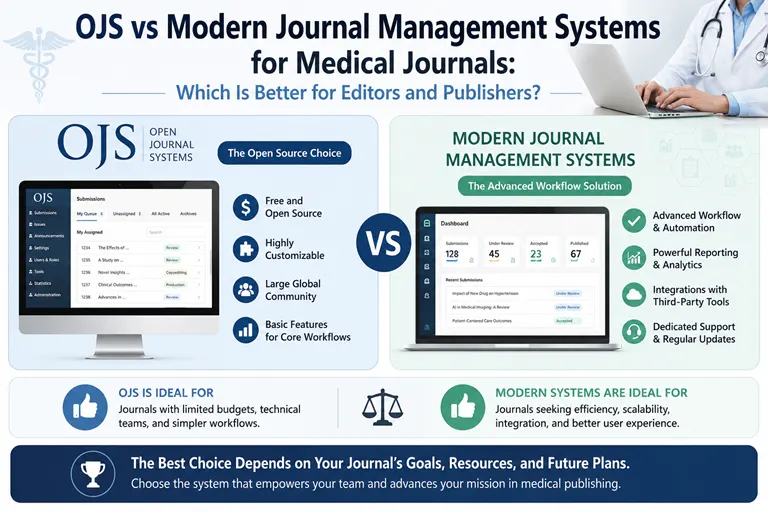
This is why many publishers ask an important question: Should we continue with OJS, or should we move to a more modern journal management system?
The answer depends on several factors, including the size of the journal, internal technical capacity, editorial workflow complexity, support expectations, DOI publishing requirements, and long-term growth plans. A small journal with strong in-house technical resources may be comfortable managing OJS independently. Another journal may prefer a system that offers a cleaner interface, faster support, reduced plugin dependency, easier editorial handling, and a more managed experience.
In this article, we compare OJS vs modern journal management systems for medical journals, with special attention to the needs of journals in obesity, endocrinology, diabetes, and related medical specialties. The goal is not to criticize one model or blindly promote another. Instead, the goal is to help editors, publishers, and journal owners understand which type of platform is the better fit for their workflow, growth stage, and operational priorities.
Table of Contents
- Why platform choice matters for medical journals
- What is OJS?
- What is a modern journal management system?
- OJS vs modern systems: key differences at a glance
- Submission and editorial workflow comparison
- Peer review management and communication experience
- DOI, metadata, and publication readiness
- Technical maintenance, upgrades, and support
- Design, usability, and author experience
- When OJS is a good choice
- When a modern journal management system may be a better choice
- Migration considerations for existing journals
- Practical checklist before choosing a journal platform
- Frequently asked questions
- Conclusion
1. Why Platform Choice Matters for Medical Journals
A journal platform is not just a website. It is the operational backbone of the journal. It affects how manuscripts are submitted, how editors assign reviewers, how revisions are tracked, how authors receive communication, how articles are published, and how discoverable the final content becomes.
For a medical journal, the platform becomes even more important because:
● multiple article types may be handled at the same time, including original research, reviews, case reports, editorials, and short communications
● clinical and ethical documentation may need to be collected during submission
● reviewer communication often needs to be organized carefully
● DOI registration and article metadata must be managed properly
● publication timelines matter for authors and institutions
● the journal must maintain a professional image for readers, authors, and editorial board members
If the journal platform is difficult to manage, the editorial team may spend more time troubleshooting the system than actually handling scholarly content. Delays in peer review, poor communication, missing metadata, or broken article workflows can damage author confidence and reduce submission quality over time.
This is why choosing the right journal management platform is not just a technical decision. It is a strategic publishing decision.
2. What Is OJS?
Open Journal Systems (OJS) is an open-source journal publishing and manuscript management platform developed to support scholarly publishing workflows. It is widely used by universities, societies, independent journals, and research institutions around the world.
To GetOJS for your journal say hi on whatsapp: +918200385143 or send email on inquiry@ojscloud.com or visit websites: www.OJSCloud.com www.getojs.com
OJS is designed to help journals manage:
● author submissions
● editorial review
● peer review
● copyediting and production workflows
● issue publishing
● archives and article pages
● user roles such as author, reviewer, editor, and journal manager
Because OJS is open source, journals can install it on their own servers or work with a hosting partner to deploy and maintain it. This makes it attractive for institutions that want control, flexibility, and a known academic publishing ecosystem.
Why many journals use OJS
OJS remains popular for several reasons:
● it is established and widely recognized in scholarly publishing
● it supports end-to-end journal workflow
● it can be customized to varying degrees
● it is suitable for institutions that want an open-source solution
● many journals are already familiar with its structure
For many journals, OJS has served as an important foundation for online publishing.
3. What Is a Modern Journal Management System?
A modern journal management system such as ScholarJMS is a platform built to handle manuscript submission, editorial workflow, peer review, publication, and article management with a stronger emphasis on ease of use, managed support, workflow simplification, cleaner interface design, and reduced operational friction.
While features vary from one platform to another, modern systems are often designed to reduce the technical burden on the journal team and improve the experience of:
● authors submitting manuscripts
● editors screening and assigning papers
● reviewers handling invitations and review tasks
● production teams preparing accepted articles for publication
● publishers managing DOI, metadata, issue release, and archives
A modern journal platform may offer benefits such as:
● a more intuitive dashboard for editors and authors
● simplified role-based workflow
● easier configuration of submission forms and editorial stages
● better UI for article tracking
● integrated or streamlined DOI workflow support
● mobile-friendly and cleaner journal presentation
● reduced dependency on multiple plugins for core tasks
● direct platform support and managed maintenance
The core idea is not simply to replace OJS with a “newer website.” The core idea is to reduce friction in the journal’s publishing operations and give editorial teams a platform that feels easier to manage day to day.
4. OJS vs Modern Systems: Key Differences at a Glance
Both OJS and modern journal management systems aim to support scholarly publishing, but they differ in how they approach implementation, management, and user experience.
To explore more difference visit: https://scholarjms.com/compare
OJS often appeals to journals that want:
● an open-source framework
● flexibility and control over installation
● institutional ownership of a known academic platform
● the ability to manage the system with internal technical resources or an OJS support partner
Modern journal management systems often appeal to journals that want:
● a more guided and support-oriented publishing experience
● reduced technical dependency on in-house IT teams
● cleaner dashboards and easier navigation
● simplified editorial operations
● more direct help with workflow setup and publishing execution
● a system that feels more “managed service” than “self-maintained software”
In other words, the difference is often not just about features. It is about operational model.
One model gives the journal a powerful open-source environment that may require more setup, configuration, maintenance, and technical familiarity. The other model often focuses on helping the journal run faster with less technical friction.
5. Submission and Editorial Workflow Comparison
OJS workflow experience
OJS is capable of handling the full manuscript lifecycle, from submission to publication. However, depending on how the journal is configured and how familiar the editorial team is with the system, some users find the workflow more structured than intuitive. Editors may need training to navigate the different stages, roles, settings, and submission components effectively.
For journals with experienced editorial administrators and technical support, this may not be a problem. But for smaller medical journals or newly launched journals, the learning curve can feel significant.
Modern system workflow experience
Modern journal management systems typically aim to make editorial handling more straightforward. The focus is often on reducing the number of confusing steps between submission, screening, reviewer assignment, revision, acceptance, and publication.
For example, a more modern workflow may emphasize:
● cleaner manuscript status tracking
● simplified reviewer assignment flow
● easier editorial notes and communication visibility
● quicker access to author files and revision history
● reduced clutter in dashboard screens
Why this matters for medical journals
Medical journals often process manuscripts that involve:
● ethics approval documents
● patient consent information
● figure-heavy case reports
● multiple revisions
● reviewer comments on methodology and clinical interpretation
● supplementary tables and data files
A system that makes editorial tracking easier can reduce delays and improve the overall experience for the editorial office.
6. Peer Review Management and Communication Experience
Peer review is one of the most sensitive parts of journal management. A platform must support not only reviewer assignment but also timely communication, reminders, confidential handling, and revision tracking. For more detail visit: www.scholar9.com
OJS and peer review
OJS can manage peer review effectively, but the experience depends heavily on configuration, workflow familiarity, and how well the editorial team uses the system. Some journals operate very successfully on OJS for years. Others find that reviewer invitation management, user role handling, and communication workflows can become administratively heavy if the team is not fully comfortable with the platform.
Modern systems and peer review
A modern journal system usually tries to make peer review feel less operationally burdensome. The system may present reviewer status, manuscript stages, author correspondence, and decision pathways more clearly. This can help editors spend less time navigating the platform and more time evaluating the content and coordinating academic decisions.
The communication factor
A journal platform should help editorial teams answer practical questions quickly:
● Has the reviewer accepted the invitation?
● Which manuscript is waiting for revision?
● Which author has not completed a required step?
● Which article is ready for copyediting?
● Which accepted paper still needs DOI and final publication action?
When these answers are difficult to trace inside the platform, the editorial workflow slows down.
7. DOI, Metadata, and Publication Readiness
For a medical journal, a publishing platform should not stop at peer review. It must also support the publication stage, where article presentation, DOI assignment, metadata structure, and archive organization become critical.
OJS and DOI readiness
OJS can support DOI-related workflows and metadata-driven publishing, especially when configured correctly and managed by a knowledgeable team. However, the actual experience depends on setup quality, journal version, technical maintenance, and how effectively the journal uses the platform’s available publishing features. For more detail for crossref DOI visit: www.getdoi.com
Modern systems and DOI workflow
A modern journal management system may provide a more guided publishing experience, where article-level metadata, publication records, issue handling, and DOI-ready workflows are easier to manage from the editorial side. This can be especially useful for smaller publishers or specialty journals that want DOI implementation to be part of a smoother publication process rather than a separate technical activity.
Why this matters for AOEDS-type journals
Journals in obesity, endocrinology, and diabetes often publish content that should remain citable and accessible for years. A strong platform should support:
● clean article landing pages
● DOI-ready publication workflow
● structured author metadata
● archive continuity
● issue-wise organization
● consistent article URLs and publishing records
If the journal platform makes publication cumbersome, the journal may end up with delays or inconsistencies after acceptance, even if peer review was completed properly.
Need Crossref DOI Support for Your Journal?
If your journal is planning Crossref DOI implementation, needs support for DOI prefix setup through sponsorship, or wants help with article-level DOI workflow for research articles, reviews, case reports, and editorials, you may contact our support team directly.
WhatsApp Support: +91 82003 85143
Email: inquiry@ojscloud.com
We assist journals looking to strengthen Crossref DOI workflow, metadata handling, and article publishing infrastructure.
8. Technical Maintenance, Upgrades, and Support
This is one of the most practical decision points between OJS and a managed modern system.
OJS maintenance reality
Because OJS is a software platform that journals often host on their own infrastructure or through a service provider, maintenance can involve:
● installation and server setup
● upgrades between versions
● plugin compatibility checks
● backup management
● theme and customization handling
● troubleshooting errors or broken workflows
● email and cron configuration in some environments
For journals with strong IT support or a trusted OJS partner, this can be manageable. But for editorial teams that do not want to spend time on software administration, these tasks can become frustrating.
Modern system maintenance model
A managed modern journal platform typically reduces the journal’s direct involvement in technical maintenance. The journal team can focus more on publishing and less on server-side or system-side operations.
This can be especially useful for:
● newly launched medical journals
● society journals without dedicated IT staff
● editors who want fast operational support
● journals planning growth but lacking internal technical capacity
Why support quality matters
A journal platform is not only judged by its features. It is also judged by what happens when something goes wrong. If author emails stop sending, reviewer assignments fail, article pages break, or DOI-related publication steps become confusing, the quality and speed of support matter immensely.
9. Design, Usability, and Author Experience
A journal’s public-facing website and internal workflow interface both shape how the journal is perceived.
OJS and design flexibility
OJS journals can be customized, but design quality depends on theme setup, technical customization, and the resources available to the journal. Some OJS journals look excellent. Others look dated or inconsistent because the journal has not invested in UI improvement or theme refinement.
Modern platforms and usability focus
Many modern journal management systems place more emphasis on:
● clean interface design
● better author submission experience
● simpler navigation for editors and reviewers
● mobile-friendly layouts
● modern journal presentation and branding
Why this matters for authors
Authors increasingly judge journals by their submission experience. If the submission form is confusing, the dashboard is hard to understand, or the workflow feels outdated, authors may feel less confident about the journal, even if the editorial standards are good.
For specialty medical journals competing for quality submissions, author experience is not a minor issue. It directly affects conversion from visitor to submitter.
10. When OJS Is a Good Choice
OJS can be an excellent choice when the journal’s needs align with its strengths.
OJS may be a good fit if:
● the journal wants an open-source platform
● the institution prefers control over hosting and infrastructure
● the editorial office already understands OJS well
● the journal has access to internal technical support or a dependable OJS service partner
● the journal is comfortable managing updates, workflow configuration, and platform maintenance
● the journal values an established academic publishing environment and is willing to invest in setup and management
For many journals, OJS remains a practical and respected solution. There is no reason to abandon it simply because newer systems exist.
11. When a Modern Journal Management System May Be a Better Choice
A modern journal management system may be the better choice when the journal wants to reduce technical burden and prioritize a smoother publishing experience.
A modern system may be a better fit if:
● the editorial team wants a simpler and cleaner workflow
● the journal does not want to manage software maintenance internally
● faster support and guided platform assistance are important
● the journal wants a modern author and editor experience
● DOI workflow, article publication, and metadata handling need to be easier operationally
● the journal is migrating from a difficult or fragmented workflow environment
● the publisher wants a more managed publishing infrastructure rather than a self-maintained software environment
This is especially relevant for independent journals, specialty medical journals, and newly expanding publications that want to focus on content quality, peer review, and journal growth instead of backend system complexity.
12. Migration Considerations for Existing Journals
A journal that is already running on OJS or another system should not migrate impulsively. Migration should be a planned editorial and technical decision.
Questions to ask before migration
● Is the current platform slowing down editorial operations?
● Are authors or editors regularly facing workflow issues?
● Is technical maintenance becoming difficult?
● Is DOI or article publication management inconsistent?
● Does the journal want a better author-facing website experience?
● Is the editorial team looking for more direct operational support?
What a migration plan should consider
A good migration plan should evaluate:
● existing archives and article URLs
● DOI continuity and redirect planning
● issue and article metadata transfer
● author and editor workflow continuity
● design improvement opportunities
● training for editorial staff
● timeline for moving without disrupting current submissions
A migration should improve the journal’s workflow, not create confusion. This is why planning, platform assessment, and support quality matter so much.
13. Practical Checklist Before Choosing a Journal Platform
Before selecting OJS or a modern journal management system, journal owners and editors should review the following questions.
Workflow checklist
● How many manuscripts do we handle each month or year?
● Do we have different article types with different editorial needs?
● How comfortable is our team with technical configuration and platform administration?
● Do we need fast support when editorial or technical issues arise?
● How important is a modern author-facing interface to us?
● Do we want a self-managed platform or a more managed service model?
● Does the platform support our DOI and article publication workflow comfortably?
● Will the platform scale if the journal grows?
● Can the platform support future indexing readiness through good metadata and clean article pages?
● How much time does our editorial office want to spend on publishing operations versus system troubleshooting?
Decision principle
The best platform is not necessarily the most famous one or the newest one. It is the one that matches the journal’s editorial capacity, technical comfort level, publication goals, and long-term growth strategy.
If your journal is comparing OJS hosting, OJS migration, modern journal platform options, or DOI-ready publishing systems, you may also find it useful to discuss your workflow requirements with a publishing support team before making the final decision.


Mr. Darshan Patel (ME-CE)
COO & Journal Publishing Technology Consultant
Sequence Research & Development Pvt. Ltd.
Ahmedabad | Gujarat | India
Email for Crossref Prefix: inquiry@ojscloud.com
WhatsApp Crossref DOI: +918200385143
www.ScholarJMS.com
14. Frequently Asked Questions
1. Is OJS still a good platform for medical journals?
Yes. OJS is still a strong and widely used platform for many medical journals, especially when the journal has appropriate technical support and a team familiar with its workflow.
2. Why do some journals move away from OJS?
Some journals move because they want a simpler workflow, faster support, a more modern interface, easier maintenance, or a more managed editorial and publishing environment.
3. Is a modern journal management system always better than OJS?
Not necessarily. The better system depends on the journal’s needs, technical capacity, workflow complexity, and support expectations.
4. Can a journal migrate from OJS without losing old articles?
Yes, but migration must be planned carefully. Archives, article URLs, metadata, issue records, and DOI continuity all need to be handled properly.
5. What should a medical journal prioritize when choosing a platform?
A medical journal should prioritize submission workflow, editorial usability, peer review handling, DOI readiness, metadata quality, support reliability, and long-term publishing stability.
6. Should DOI workflow influence platform selection?
Yes. DOI and metadata handling are central parts of modern journal publishing, so the journal platform should support them comfortably.
15. Conclusion
The choice between OJS and a modern journal management system is not a matter of one platform being universally “good” and the other “bad.” Both approaches can support scholarly publishing. The real question is which model best matches the needs of your journal.
If your journal values open-source flexibility, institutional control, and has access to technical support, OJS may remain an excellent choice. It is a respected platform with a long history in academic publishing and continues to serve many journals effectively.
However, if your journal is looking for simpler editorial operations, faster support, cleaner workflow management, easier DOI-ready publishing, and a more modern author-editor experience, then a modern journal management system may be the better long-term fit. This is particularly true for specialty medical journals that want to focus on quality publishing and growth without carrying unnecessary technical burden.
For journals in obesity, endocrinology, diabetes, metabolic medicine, thyroid disorders, and related clinical sciences, the platform should ultimately support one core objective: efficient, professional, and trustworthy scholarly publishing. That means the system should help the journal handle submissions smoothly, support peer review properly, maintain accurate article records, manage DOI and metadata effectively, and present published work in a way that builds confidence among authors, editors, reviewers, and readers.