


How to Start an Online Medical Journal in 2026: Website, ISSN, DOI, Peer Review, and Indexing Checklist
How to Start an Online Medical Journal in 2026: Website, ISSN, DOI, Peer Review, and Indexing Checklist
Introduction
Starting a medical journal in 2026 is both exciting and demanding. On one hand, digital publishing technology has made it easier than ever to launch an online journal. On the other hand, authors, reviewers, institutions, and indexing bodies now expect a much higher level of professionalism from new journals. A modern medical journal is not just a website with PDF files. It is a complete publishing ecosystem that must support journal branding, manuscript submission, peer review, article publication, DOI assignment, ISSN readiness, editorial workflows, and long-term indexing goals.
Many editors, professors, research groups, hospitals, medical colleges, and academic societies start with the same question:
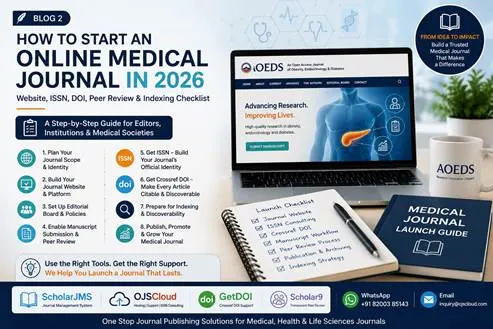
How do I start an online medical journal properly?
That question is important because the answer is not just “buy a domain and upload articles.” A credible medical journal requires planning at multiple levels:
● defining the journal’s scope and editorial identity
● choosing a proper journal website and manuscript management system
● setting up author, reviewer, and editor workflows
● planning for ISSN application
● arranging Crossref DOI support
● publishing articles with consistent metadata
● preparing for discoverability, Google indexing, and future abstracting and indexing opportunities
● building a structure that authors and reviewers will trust
If these elements are ignored at the beginning, the journal may still go live, but it may struggle with poor workflow, weak credibility, inconsistent publishing standards, and technical limitations that become painful later.
This is exactly why a journal launch should be treated as a publishing infrastructure project, not just a website project.
In this guide, I will walk through a practical 2026 checklist for starting an online medical journal, covering the key areas every journal founder should think about: website setup, journal management system, ISSN consulting, Crossref DOI support, peer review workflow, indexing preparation, and long-term journal growth. I will also share the kind of support ecosystem that can make this process much easier for new journals, especially if you want a one-stop solution rather than coordinating multiple vendors.
Table of Contents
- Define the journal’s academic scope and publishing identity
- Decide whether you are building a journal website or a full journal management system
- Choose the right journal platform before you publish your first call for papers
- Plan the essential website pages every medical journal should have
- Set up a real manuscript submission and peer review workflow
- Prepare your editorial board, policies, and publishing governance
- Plan your ISSN strategy before the journal grows
- Arrange Crossref DOI support from the beginning
- Think beyond PDFs: build article-level publishing structure
- Prepare your journal for indexing and long-term discoverability
- Decide how you will manage transparency, trust, and peer review quality
- Build a support system for ongoing technical and publishing operations
- A practical one-stop stack for launching a medical journal in 2026
- Full checklist: what you should complete before calling your journal “live”
- Who should use this medical journal launch model
- Direct help for journal website, ISSN, DOI, and platform setup
- Frequently asked questions
- Conclusion
1. Define the Journal’s Academic Scope and Publishing Identity
Before you choose a journal platform or build a website, you need to define what the journal actually is.
This sounds obvious, but many journals make the mistake of jumping into design and software before clarifying the journal’s academic identity. A serious medical journal should have a clear foundation in terms of:
● subject scope
● target audience
● article types
● editorial focus
● publication ethics position
● journal title and subtitle presentation
● publishing frequency plan
● intended geographic and scholarly audience
Questions to answer before launch
● Will the journal focus on a narrow specialty like endocrinology, cardiology, public health, oncology, dentistry, or nursing?
● Will it be multidisciplinary within health sciences?
● Will it publish original research only, or also reviews, case reports, short communications, editorials, and clinical perspectives?
● Will it target local institutional submissions first, or aim for broader national and international reach?
● What editorial and peer review model will you follow?
Why this matters
Your journal’s scope affects everything that comes later:
● the website structure
● the journal title presentation
● the editorial board composition
● the author guidelines
● the reviewer network
● the ISSN application positioning
● the indexing strategy
● the type of manuscript system you need
A well-defined scope makes the journal feel serious from day one.
2. Decide Whether You Are Building a Journal Website or a Full Journal Management System
This is one of the most important decisions in the entire launch journey.
A lot of new journals think they need a website. In reality, they need two connected things:
- a journal website for public-facing visibility
- a journal management system for submission, review, editorial decisions, and publishing workflow
If you only build a simple website and collect submissions by email, you may face problems very quickly.
A basic website-only model often creates:
● manual submission tracking
● email chaos between authors, editors, and reviewers
● no clear review timeline control
● difficulty managing revisions
● inconsistent article records
● extra editorial burden
● weak professionalism when authors evaluate your journal
A real journal management system gives you:
● structured manuscript submission
● author accounts
● reviewer workflow
● editor decision handling
● revision tracking
● organized article records
● smoother editorial operations as the journal grows
This is why I always recommend that a new medical journal should launch with a proper journal publishing platform, not just a brochure-style website.
3. Choose the Right Journal Platform Before You Publish Your First Call for Papers
Once you know you need more than a static website, the next question becomes:
Which platform should you use for your medical journal?
In 2026, your journal platform should support more than page design. It should help you operate the journal.
What a good medical journal platform should support
● online manuscript submission
● author, reviewer, and editor roles
● article workflow management
● issue and archive structure
● article landing pages
● metadata-oriented publishing
● DOI-friendly article setup
● long-term scalability as submissions grow
● professional presentation for authors and institutions
Why this decision should be made early
Changing platforms after you already have articles, authors, reviewers, and editorial records can be difficult. It is much better to choose a solid foundation before you start inviting submissions.
A practical platform route for new journals
For journals that want a modern journal-focused system, one strong option is ScholarJMS, which is designed specifically for journal website and manuscript workflow management. It is especially useful for journals that want a system built around scholarly publishing logic rather than a generic content management setup.
If a journal also wants help with broader journal launch support, OJS guidance, migration, publishing consulting, and ISSN-related readiness, the connected support available through OJSCloud can be very valuable.
4. Plan the Essential Website Pages Every Medical Journal Should Have
A medical journal website should not look incomplete or improvised. Before launch, the journal should have a proper set of public pages that help authors, readers, reviewers, and indexing bodies understand the journal clearly.
Core pages every medical journal should prepare
● Home
● About the Journal
● Aims and Scope
● Editorial Board
● Instructions for Authors
● Peer Review Policy
● Publication Ethics / Malpractice Statement
● Open Access Policy if relevant
● Copyright and Licensing Policy
● Article Processing Charges / Publication Fee page if applicable
● Current Issue / Archives
● Submit Manuscript / Login
● Contact Us
● Privacy Policy and Terms, where relevant
● Indexing / Abstracting page, once applicable
● Reviewer Guidelines, if the journal actively recruits reviewers
Why these pages matter
These pages do more than fill menu space. They establish trust. Authors want to know:
● who runs the journal
● what the journal publishes
● how peer review works
● whether the journal has a real editorial process
● where to submit
● what publication policies apply
A weak or incomplete website creates doubt, especially in the medical field where trust is critical.
5. Set Up a Real Manuscript Submission and Peer Review Workflow
A medical journal should never underestimate the importance of workflow.
If the journal receives only two or three manuscripts, email may seem manageable. But if the journal is serious about growth, email-only workflow becomes risky and inefficient.
A proper journal workflow should support:
● manuscript submission by authors
● automatic acknowledgment and submission record creation
● editor assignment
● reviewer invitation and reviewer response tracking
● peer review status management
● revision handling
● final editorial decision recording
● movement of accepted papers toward publication
Why this matters in medical publishing
Medical journals often handle:
● ethical declarations
● conflict of interest forms
● patient-related or clinical research submissions
● multiple reviewer comments
● revised files and version tracking
● editorial accountability
This is much easier inside a structured journal platform than inside scattered email chains.
What I recommend
For a new medical journal, use a system that combines website and editorial workflow from the start. This is one of the strongest reasons journals explore platforms like ScholarJMS instead of relying only on a manually managed website.
6. Prepare Your Editorial Board, Policies, and Publishing Governance
Technology alone does not make a journal credible. Governance matters just as much.
Before launch, a medical journal should prepare:
● a clearly presented editorial board
● editor-in-chief details
● associate / section editor roles if applicable
● peer review model description
● ethics and misconduct policy
● plagiarism / similarity check policy
● retraction and correction approach
● authorship and conflict-of-interest expectations
Why this matters for new journals
A medical journal is entering a space where research integrity matters deeply. A journal that looks vague about policies can lose trust quickly.
Why governance also helps with ISSN and indexing readiness
When your website clearly presents:
● editorial leadership
● publishing policies
● scope
● issue structure
● article publishing intent
It strengthens the journal’s seriousness and helps prepare it for the next stages of publishing development.
7. Plan Your ISSN Strategy Before the Journal Grows
One of the most common mistakes new journal founders make is postponing ISSN planning until after the journal is already active. In many cases, it is much smarter to think about ISSN readiness at the beginning.
Why ISSN matters
ISSN is a core identity element for a serial publication. For an online journal, it helps establish the journal as a recognized continuing publication rather than just a website section.
What many new editors do not know
ISSN is not just a form-filling exercise. Before applying, you should think about:
● journal title consistency
● scope presentation
● website completeness
● publication format and frequency clarity
● archive and issue presentation
● contact details and publishing information
● overall professionalism of the journal site
Why ISSN consulting can save time
Many new publishers are unsure:
● when to apply
● what should be ready first
● what the ISSN office may expect to see
● how to present the journal properly before submission
This is where consulting support becomes useful.
For journals that want help with ISSN consulting, journal website readiness, and launch guidance, support through OJSCloud can be extremely practical.
Need help with ISSN, journal website, or full medical journal setup?
If you are planning to launch a new medical journal and want help with ISSN consulting, journal platform setup, or complete journal website development, you can directly contact our publishing support team.
Direct Journal Launch Support
● WhatsApp: +91 82003 85143
● Email: inquiry@ojscloud.com
Services you can discuss
● New journal website setup
● ScholarJMS platform setup
● OJS to ScholarJMS migration
● ISSN consulting for journals
● Journal workflow planning
● Medical journal launch support
8. Arrange Crossref DOI Support from the Beginning
If you want your medical journal to look credible and future-ready, DOI planning should happen early.
Why DOI matters for a medical journal
DOI helps create a stable scholarly identity for each published article. It supports:
● persistent article links
● professional citation handling
● better long-term article referencing
● stronger publishing credibility
● compatibility with modern academic publishing expectations
Why new journals should not postpone DOI planning
A common mistake is publishing several issues first and only later thinking about DOI. This can create unnecessary confusion around metadata consistency and article registration workflows.
A better approach
Think about DOI before you publish the first issue. Ask:
● how will article DOIs be assigned?
● who will support Crossref DOI access?
● what article metadata workflow will be followed?
● how many DOI records may be needed annually?
● how will DOI fit into the article publication process?
For journals looking for Crossref DOI support and DOI workflow planning, GetDOI is a highly relevant service to evaluate.
9. Think Beyond PDFs: Build Article-Level Publishing Structure
A journal should not operate as a “PDF dump” where articles are uploaded without strong structure.
A better article publishing model includes:
● article title page on the website
● author and affiliation display
● abstract or summary display where relevant
● citation-friendly metadata
● DOI-ready structure
● PDF access and, where possible, richer article presentation
● issue and archive linkage
● publication date and article history visibility where appropriate
Why article pages matter
Article-level pages improve:
● discoverability
● professionalism
● citation presentation
● long-term journal value
● future indexing readiness
● user trust
This is one reason journal-focused platforms matter so much. A platform built for journal publishing will generally handle article organization much better than a generic website builder.
10. Prepare Your Journal for Indexing and Long-Term Discoverability
A new journal may not be ready for major indexing services immediately, but it should still be built with discoverability in mind.
What discoverability planning includes
● clean journal structure
● article-level pages
● consistent issue archives
● proper metadata-oriented publishing
● clear policies and editorial pages
● DOI strategy
● searchable website architecture
● strong Google indexability
● a publishing pattern that shows continuity and seriousness
Why this matters
Indexing is usually a later milestone, but poor early website structure can slow you down later. If the journal is built properly from the beginning, it becomes easier to move toward future goals.
A new journal should think in stages:
- launch professionally
- publish consistently
- build trust and article volume
- improve discoverability and indexing readiness over time
11. Decide How You Will Manage Transparency, Trust, and Peer Review Quality
Medical publishing requires trust. Authors want to know that your journal takes review quality seriously. Readers want to know the journal is credible. Institutions want to know the journal is not just another low-discipline publication site.
A serious journal should think about:
● peer review clarity
● editorial accountability
● ethical decision-making
● transparency of process
● conflict-of-interest handling
● research credibility signals
As journals mature, they may also want to think about more modern research-trust approaches and transparent peer review direction.
This is where a platform ecosystem such as Scholar9 can become relevant for journals interested in broader peer review transparency and research trust frameworks.
12. Build a Support System for Ongoing Technical and Publishing Operations
Launching the journal is only the beginning. Once the site is live, the real work starts:
● author queries begin
● submissions start coming in
● editorial board members need access
● issues must be published
● policies need updates
● DOI workflows need attention
● technical changes arise
● new indexing goals appear
Why ongoing support matters
If the journal is dependent on a one-time freelancer or a generic web agency, future growth can become difficult.
A journal needs a support partner or ecosystem that understands:
● journal website operations
● manuscript workflow
● publishing structure
● DOI and metadata logic
● journal-specific technical needs
● academic publishing realities
That is why many journal owners now prefer working with a connected ecosystem rather than separate unrelated vendors.
13. A Practical One-Stop Stack for Launching a Medical Journal in 2026
If you are starting a medical journal and want a practical one-stop route rather than managing separate vendors for every step, a very workable ecosystem is:
13.1 ScholarJMS
Best for:
● journal website setup
● manuscript submission workflow
● editor / reviewer / author management
● article and issue publishing structure
● long-term journal operations
13.2 OJSCloud
Best for:
● journal launch guidance
● OJS-related support and migration consulting
● publishing consulting
● ISSN consulting and journal readiness support
● broader technical help for journals
13.3 GetDOI
Best for:
● Crossref DOI support
● DOI workflow planning
● DOI-related guidance for new journals
13.4 Scholar9
Best for:
● modern transparent peer review ecosystem direction
● research trust and scholarly workflow support
Why this stack is powerful
Instead of managing:
● one vendor for website
● one for DOI
● one for ISSN consulting
● one for manuscript system
● one for peer review ideas
you can work within a more connected journal publishing ecosystem.
14. Full Checklist: What You Should Complete Before Calling Your Journal “Live”
Here is a practical pre-launch checklist for a new online medical journal.
Journal identity
● Journal title finalized
● Scope and aims clearly written
● Publication frequency planned
● Editorial board identified
● Contact details ready
Website and platform
● Journal website live on proper domain
● Submission system configured
● Archive / issue structure ready
● Article page structure ready
● Author and reviewer workflow tested
Core pages
● About Journal
● Aims and Scope
● Editorial Board
● Author Guidelines
● Peer Review Policy
● Publication Ethics
● Contact Page
● Copyright / licensing / APC page if relevant
Publishing readiness
● First issue planning done
● Article template and metadata approach decided
● DOI workflow discussed
● ISSN consulting / application strategy reviewed
● Editorial handling SOP created
Growth readiness
● Google indexing basics checked
● long-term technical support identified
● reviewer invitation process planned
● journal email workflow established
● future indexing roadmap documented
If most of these are not ready, the journal may still technically launch, but it will not launch strongly.
15. Who Should Use This Medical Journal Launch Model
This model is especially useful for:
Universities and medical colleges
that want to launch institutional journals in medicine, dentistry, pharmacy, nursing, or allied health sciences.
Professors and editorial teams
who want to build a specialty journal with a serious peer review and publishing workflow.
Medical societies and associations
that want to establish a society journal rather than depend on email-based publishing.
Existing small journals
that already publish articles but need a better website, DOI workflow, or manuscript system.
OJS journals considering modernization
that want to explore a more guided or differently structured journal management environment.
16. Direct Help for Journal Website, ISSN, DOI, and Platform Setup
If you are planning to launch a medical journal, health sciences journal, pharmacy journal, nursing journal, dental journal, or any scholarly journal, and want help with the complete setup, you can directly reach out for support.
We can help with:
● Journal website development
● ScholarJMS setup and onboarding
● OJS to ScholarJMS migration
● ISSN consulting for new journals
● Crossref DOI support planning
● Journal workflow and editorial system setup
● Medical journal launch consulting
● Article publication structure planning
Explore the platforms
● Journal Management Platform: ScholarJMS
● Journal Website / OJS / ISSN Consulting Support: OJSCloud
● Crossref DOI Support: GetDOI
● Transparent Peer Review Ecosystem: Scholar9
Contact Now
● WhatsApp: +91 82003 85143
● Email: inquiry@ojscloud.com
17. Frequently Asked Questions
1. Can I start a medical journal with only a website and email submissions?
Technically yes, but it is not ideal for long-term growth. A proper journal should have a manuscript management workflow, reviewer handling, editorial tracking, and article publishing structure.
2. When should I apply for ISSN for a new journal?
It is best to plan ISSN early, once the journal website structure, title presentation, scope, and publishing identity are reasonably ready. Many journals benefit from ISSN consulting before applying.
3. Do I need DOI from the beginning?
If you want the journal to look professional and future-ready, it is wise to discuss DOI planning from the beginning rather than treating it as a later add-on.
4. What is the difference between a journal website and a journal management system?
A journal website is the public-facing presence of the journal. A journal management system handles the workflow behind it, including submission, review, editorial decisions, and publishing operations.
5. Is this process useful only for medical journals?
No. While this guide is written for medical journals, the same structure is useful for journals in pharmacy, dentistry, nursing, public health, engineering, management, law, education, and multidisciplinary research.
6. Who can help me launch a journal with website, ISSN guidance, DOI support, and workflow setup?
If you want a one-stop ecosystem, you can explore ScholarJMS, OJSCloud, GetDOI, and Scholar9, and directly contact the support team for guidance.
18. Conclusion
Starting an online medical journal in 2026 requires much more than choosing a journal title and uploading a few articles. A credible journal needs a professional website, a real manuscript workflow, editorial governance, ISSN planning, DOI readiness, article-level publishing structure, and a long-term growth strategy. The earlier these elements are planned, the stronger the journal’s foundation will be.
If you are serious about building a journal that authors, reviewers, institutions, and future indexing systems can trust, then the right question is not merely “How do I make a journal website?” The right question is:
How do I build a complete publishing system for my journal?
That is where a connected ecosystem can make a huge difference. Instead of coordinating separate vendors for website development, manuscript workflow, ISSN consulting, DOI support, and peer review direction, it is often far more practical to work with a one-stop journal publishing support stack such as:
● OJSCloud
● GetDOI
● Scholar9
If you are planning to launch a new journal or upgrade an existing one, I strongly recommend getting the platform, ISSN, DOI, and workflow discussion started early.
Want help launching your journal?
You can directly contact us for:
● new journal website setup
● ScholarJMS onboarding
● ISSN consulting
● Crossref DOI support
● OJS migration
● medical journal launch planning
Direct Contact
● WhatsApp: +91 82003 85143
● Email: inquiry@ojscloud.com