


How to Get ISSN and Crossref DOI for a New Journal: A Practical Guide for Editors and Publishers
How to Get ISSN and Crossref DOI for a New Journal: A Practical Guide for Editors and Publishers
Introduction
One of the most common questions asked by new journal founders, editors, academic institutions, and research societies is:
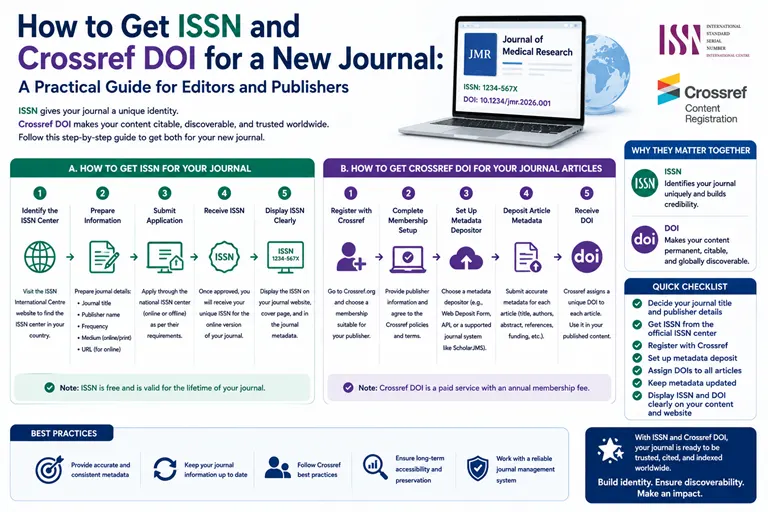
How do I get ISSN and Crossref DOI for my journal?
It is an important question, because a new journal may look incomplete or unprepared without a clear plan for journal identity, article identification, metadata structure, and publishing credibility. In modern scholarly publishing, two terms appear again and again during the launch process:
● ISSN
● DOI
Almost every new editor hears these terms early, but many do not fully understand the difference between them, when they should be arranged, what should be ready before applying, or how they fit into the bigger picture of launching a professional academic journal website.
Some journal owners assume ISSN and DOI are the same thing. Others think DOI can wait until much later. Some apply for ISSN before the journal website is properly prepared. Others publish articles first and only later realize they need a better DOI workflow. These mistakes are common, especially when a journal is being launched by an academic team with strong subject expertise but limited publishing infrastructure experience.
The truth is that ISSN and DOI are both important, but they solve different problems.
● ISSN helps define the identity of the journal as a serial publication.
● DOI helps define the identity of each published article or item.
A strong journal launch should think about both, but it should do so in the right order and with the right preparation.
In this guide, I will explain what ISSN and Crossref DOI actually are, how they differ, when a new journal should think about each one, what needs to be ready before applying, what common mistakes to avoid, and how editors can build a complete journal launch workflow that includes website setup, journal management, ISSN readiness, DOI support, and long-term publishing growth.
I will also explain why many new journals benefit from working with a connected ecosystem such as OJSCloud, GetDOI, ScholarJMS, and Scholar9 instead of trying to solve each piece separately.
Table of Contents
- What is ISSN and why does a journal need it?
- What is Crossref DOI and why does a journal need it?
- ISSN vs DOI: what is the actual difference?
- What should be ready before applying for ISSN?
- What should be ready before planning Crossref DOI for a journal?
- Why new journals should think about ISSN and DOI early, but not carelessly
- Common mistakes editors make with ISSN and DOI
- How to prepare your journal website before applying for ISSN
- How DOI fits into article publishing workflow
- Direct vs sponsored DOI routes: what new journals should understand
- Why journal platform choice matters for ISSN and DOI readiness
- A practical one-stop route for journal website, ISSN consulting, and DOI support
- Step-by-step checklist for a new journal
- Who should seek ISSN and DOI support early
- Direct help for ISSN consulting, Crossref DOI, and journal launch
- Frequently asked questions
- Conclusion
1. What Is ISSN and Why Does a Journal Need It?
ISSN stands for International Standard Serial Number. It is a unique identifier assigned to serial publications such as journals, magazines, continuing bulletins, and other ongoing publications.
For a scholarly journal, ISSN is one of the most important identity elements because it helps establish the journal as a recognized continuing publication rather than just a standalone website or collection of documents.
In simple terms, ISSN helps answer:
● What is the official identity of this journal as a serial publication?
● How can this journal be uniquely distinguished from other publications with similar names?
● How should libraries, databases, and publishing systems identify this journal?
Why ISSN matters for a new journal
A journal without ISSN may still exist online, but it often looks incomplete from a publishing standpoint. ISSN helps give the journal a more formal identity and supports the overall seriousness of the publication.
ISSN is usually associated with the journal as a publication, not with individual articles
That distinction is important because DOI works differently. ISSN belongs to the journal-level identity, while DOI is generally used at the article or content-item level.
2. What Is Crossref DOI and Why Does a Journal Need It?
DOI stands for Digital Object Identifier. In journal publishing, DOI is commonly used to assign a persistent and unique identifier to each published article or content item.
When a journal article has a DOI, it becomes easier to:
● identify and cite the article consistently
● provide a stable article link
● support modern scholarly referencing
● strengthen the professional publishing identity of the article
● connect article metadata more effectively with scholarly systems
Why Crossref DOI matters for journals
For many academic journals, DOI is no longer treated as a luxury. It is increasingly seen as part of professional scholarly publishing practice.
If a journal wants to publish articles in a way that looks modern, citable, and metadata-aware, DOI planning should be part of the discussion from the beginning.
DOI is article-focused, not journal-focused
A DOI is usually assigned to:
● research articles
● review articles
● editorials
● case reports
● issue-level items or other publishable content depending on journal policy
So while ISSN identifies the journal, DOI identifies the published article or item.
3. ISSN vs DOI: What Is the Actual Difference?
This is the most important conceptual distinction for a new editor to understand.
ISSN and DOI are not competitors
They do not replace each other. They serve different functions.
ISSN is for the journal as a serial publication
Think of ISSN as part of the journal’s official publishing identity. It helps define the journal itself.
DOI is for the published article or content item
Think of DOI as the article’s long-term scholarly identifier.
Simple comparison
ISSN
● identifies the journal
● linked to the serial publication as a continuing entity
● relevant when building the journal’s official publishing identity
● typically discussed during journal launch and journal website readiness
DOI
● identifies the article or other published item
● linked to article-level publishing and metadata
● relevant when planning article publication workflow
● usually connected with Crossref support and article publishing operations
A journal can need both
A serious online journal should ideally think about both:
● ISSN for journal identity
● DOI for article identity and citation strength
4. What Should Be Ready Before Applying for ISSN?
This is where many new journals make mistakes. They hear that a journal needs ISSN and immediately start looking for the application process, without first checking whether the journal is actually ready to present itself as a proper publication.
Before applying for ISSN, a journal should usually think about:
● final journal title
● clear journal scope and aims
● editorial board presentation
● publisher or managing organization details
● publication frequency or publishing model clarity
● proper journal website pages
● contact information
● evidence that the journal is a serious ongoing publication, not a temporary landing page
Important website readiness factors often include:
● Home page
● About the Journal
● Aims and Scope
● Editorial Board
● Instructions for Authors
● Contact page
● publication information and overall journal presentation
Why readiness matters
ISSN is not just about submitting a name. It is about presenting the journal as a real serial publication. If the website looks incomplete, inconsistent, or underdeveloped, it may create unnecessary complications.
Why ISSN consulting can be helpful
Many editors do not know:
● what pages should be ready first
● whether the journal title presentation is strong enough
● whether the journal scope is being presented correctly
● when the right moment is to apply
● how to avoid rework or confusion
This is exactly why ISSN consulting through OJSCloud can be extremely valuable for new journals.
5. What Should Be Ready Before Planning Crossref DOI for a Journal?
Just as ISSN should not be approached carelessly, DOI planning should also not be treated as a random afterthought.
Before arranging DOI support, a journal should think about:
● how article pages will be published on the website
● what metadata will be maintained for each article
● how article titles, authors, issue details, and URLs will be structured
● whether the journal has a proper workflow for final published articles
● how DOI will be assigned consistently across future issues
A journal does not need to be huge before planning DOI
Even a new journal can plan DOI early, and in many cases it should. The key is not to wait until multiple issues are already published in a disorganized way.
Why DOI planning should be workflow-based
A DOI is not just a number to paste onto a PDF. It should fit into:
● article publishing workflow
● article metadata structure
● journal website architecture
● long-term citation consistency
This is why new journals benefit from discussing DOI alongside journal platform setup and article publishing strategy.
For DOI support, planning, and Crossref guidance, GetDOI is a practical route to evaluate.
6. Why New Journals Should Think About ISSN and DOI Early, but Not Carelessly
There are two opposite mistakes new journals make:
Mistake 1: Delaying ISSN and DOI too much
Some journals publish for a long time without a proper plan for ISSN or DOI, which can create confusion and make later cleanup harder.
Mistake 2: Rushing into ISSN and DOI without preparation
Other journals try to apply for everything immediately, even though:
● the website is incomplete
● article workflow is not defined
● the journal title is not finalized
● metadata practices are not ready
● the platform structure is weak
The better approach
Think about ISSN and DOI early, but do so within a structured journal-launch plan.
A strong journal launch usually follows this logic:
- define the journal identity
- build a proper journal website and workflow
- prepare the core public pages and editorial structure
- plan ISSN readiness
- plan DOI workflow and article structure
- publish with consistency from the beginning
7. Common Mistakes Editors Make With ISSN and DOI
If you are starting a journal, avoiding common mistakes can save a lot of time.
Common ISSN mistakes
● applying before the journal website looks complete
● changing the journal title repeatedly after planning has started
● failing to present the editorial board or journal scope clearly
● not thinking about publication continuity and identity
● treating ISSN as only a formality rather than a publishing-identity milestone
Common DOI mistakes
● thinking DOI is only needed much later
● assigning DOI without a clean article publishing structure
● not maintaining proper article metadata
● publishing articles with unstable URLs or inconsistent article pages
● not planning future DOI usage volume and workflow
Common combined mistake
The biggest overall mistake is treating ISSN, DOI, website, and workflow as separate unrelated tasks. In reality, they are deeply connected.
Need help with ISSN consulting or Crossref DOI for your journal?
If you are planning to launch a new journal and want help with ISSN consulting, DOI planning, journal website setup, or OJS to ScholarJMS migration, you can directly contact our journal publishing support team.
Direct Journal Publishing Support
● WhatsApp: +91 82003 85143
● Email: inquiry@ojscloud.com
We can help with:
● ISSN consulting for new journals
● Crossref DOI support
● journal website setup
● ScholarJMS onboarding
● OJS migration
● journal workflow planning
8. How to Prepare Your Journal Website Before Applying for ISSN
Your journal website is one of the first things that reflects the seriousness of the publication. Before moving into ISSN-related planning, it is wise to make sure the site presents the journal clearly and professionally.
Minimum journal website elements to review
● clear journal title on the homepage
● About the Journal page
● Aims and Scope page
● Editorial Board page
● author guidelines
● contact details
● visible publisher or managing organization information where relevant
● archive / issue structure if already applicable
● submission information
Why this matters
A well-prepared website helps with:
● journal credibility
● smoother ISSN readiness
● author trust
● better long-term discoverability
● a stronger foundation for DOI-based article publishing later
Why platform choice matters here
A platform built for journal publishing makes it easier to organize:
● article archives
● journal pages
● submission workflow
● article landing pages
● long-term publication structure
This is one reason new journals often choose ScholarJMS as their journal management platform rather than trying to build everything manually.
9. How DOI Fits Into Article Publishing Workflow
A journal should think about DOI not as a separate administrative task, but as part of the article publication lifecycle.
A healthy DOI-aware publishing workflow looks something like this:
- manuscript is accepted
- final article files and metadata are prepared
- article is published on a stable journal webpage
- article details such as title, author information, issue information, and URL are finalized
- DOI is assigned in a structured and consistent way
- article page and PDF reflect the DOI clearly
Why this workflow matters
If DOI is handled randomly, the journal may end up with:
● inconsistent article records
● confusion about article URLs
● difficulty tracking which articles received DOI
● extra manual correction work later
Why GetDOI is useful here
New journals often need help understanding:
● how DOI allocation works
● how many DOI they may need
● how article metadata should be prepared
● whether direct membership or sponsor route makes sense
That is why GetDOI becomes a very practical support path.
10. Direct vs Sponsored DOI Routes: What New Journals Should Understand
When a journal starts exploring DOI, one of the first questions is often:
Do we need to become a direct Crossref member, or can we use a sponsored support route?
The answer depends on the journal’s scale, budget, administrative comfort, and long-term publishing strategy.
Broadly speaking, journals usually think about two possible routes:
● a direct membership route, where the journal or publisher handles DOI membership directly
● a sponsored or managed route, where DOI support is arranged through a service partner
Why this matters
New journals often prefer a more guided route because:
● it reduces complexity
● it helps with planning
● it avoids the need to learn every DOI administrative detail at the start
● it allows the editorial team to focus on publishing
Why support matters more than theory
For a new journal, the most important question is often not “Which route sounds more prestigious?” but:
Which route is practical, affordable, and sustainable for our journal right now?
This is exactly the kind of conversation where GetDOI can help.
11. Why Journal Platform Choice Matters for ISSN and DOI Readiness
A journal platform is not only about manuscript submission. It also influences how well the journal can present itself for ISSN readiness and how cleanly it can manage article-level DOI publishing.
A good journal platform helps with:
● clear website structure
● stable article pages
● issue and archive organization
● article metadata consistency
● author and editorial workflow
● future DOI-friendly publishing discipline
Why this matters
If the journal website is weak, inconsistent, or manually patched together, DOI and ISSN planning become harder.
If the platform is journal-focused, it becomes easier to build:
● a professional journal identity
● stable article publishing structure
● a workflow that supports long-term growth
This is one of the reasons many journals choose ScholarJMS as the operational base of the journal, while using OJSCloud for broader publishing support and GetDOI for DOI planning.
12. A Practical One-Stop Route for Journal Website, ISSN Consulting, and DOI Support
If you are launching a new journal, one of the biggest challenges is that the work is scattered across multiple needs:
● journal website development
● manuscript workflow setup
● ISSN readiness
● DOI support
● editorial structure
● future peer review and trust framework planning
Instead of solving each part separately, a more practical route is to use a connected publishing ecosystem:
12.1 ScholarJMS
Best for:
● journal website setup
● manuscript management workflow
● author, reviewer, and editor system
● article and issue publishing structure
12.2 OJSCloud
Best for:
● ISSN consulting
● journal launch support
● OJS support and migration
● broader publishing guidance
12.3 GetDOI
Best for:
● Crossref DOI support
● DOI planning
● sponsored DOI route discussions
● journal DOI workflow guidance
12.4 Scholar9
Best for:
● transparent peer review direction
● research trust and scholarly workflow ecosystem support
Why this one-stop route works well
Because a new journal usually does not need just a number or a certificate. It needs a complete publishing setup.
13. Step-by-Step Checklist for a New Journal
If you are launching a new academic or medical journal, here is a practical sequence to follow.
Step 1: Finalize the journal identity
● journal title
● subject scope
● editorial board
● publisher / managing organization details
● publication frequency concept
Step 2: Build the journal website properly
● home page
● about page
● aims and scope
● author guidelines
● editorial board
● contact page
● submission route
Step 3: Choose a journal platform
Use a journal-focused platform such as ScholarJMS so the journal can manage submissions, workflow, and article publishing properly.
Step 4: Review ISSN readiness
Before applying, make sure the journal website and journal identity are presented clearly. If needed, get ISSN consulting from OJSCloud.
Step 5: Plan DOI workflow
Decide how article pages, metadata, and DOI assignment will work. Discuss the most suitable route with GetDOI.
Step 6: Publish with consistency
Once the journal begins publishing, keep article structure, metadata, and editorial processes consistent from the beginning.
Step 7: Think long-term
As the journal grows, it can strengthen discoverability, indexing readiness, peer review transparency, and editorial maturity.
14. Who Should Seek ISSN and DOI Support Early
This kind of support is especially useful for:
New journal founders
who are launching a journal for the first time and do not want to make avoidable setup mistakes.
Universities and colleges
that are planning institutional journals and want proper website, ISSN, and DOI planning from the beginning.
Medical, pharmacy, management, engineering, law, education, and multidisciplinary journals
that want a more professional publishing identity and article workflow.
Existing journals without DOI
that are already publishing but now want to professionalize article identity and citation structure.
OJS journals considering modernization
that want to improve their workflow, platform experience, ISSN planning support, or DOI process.
15. Direct Help for ISSN Consulting, Crossref DOI, and Journal Launch
If you are planning to launch a new academic journal, obtain ISSN for an online journal, arrange Crossref DOI support, or set up a complete journal website and publishing workflow, you can directly contact us.
We can help with:
● ISSN consulting for new journals
● journal website readiness review
● ScholarJMS platform setup
● OJS to ScholarJMS migration
● Crossref DOI support planning
● journal workflow and article publishing setup
● complete journal launch guidance
Explore the platforms
● Journal Website and Workflow Platform: ScholarJMS
● ISSN Consulting and Journal Launch Support: OJSCloud
● Crossref DOI Support: GetDOI
● Transparent Peer Review Ecosystem: Scholar9
Contact Now
● WhatsApp: +91 82003 85143
● Email: inquiry@ojscloud.com
16. Frequently Asked Questions
1. What is the difference between ISSN and DOI?
ISSN identifies the journal as a serial publication, while DOI identifies the individual article or content item published by the journal.
2. Can a journal have ISSN but no DOI?
Yes. A journal can have ISSN without DOI. However, if the journal wants a stronger article-level scholarly identity and citation workflow, DOI planning is highly recommended.
3. Should a new journal get ISSN before DOI?
In most cases, the journal should think about ISSN readiness early because ISSN is tied to the journal’s publication identity. DOI planning should also start early, but it depends more directly on article publishing workflow.
4. Can I apply for ISSN before my journal website is complete?
It is much safer to first ensure that the journal website presents the journal properly. Incomplete or weak website presentation can complicate the process.
5. Do I need a journal management system before planning DOI?
A journal management system is not just for DOI, but it makes DOI planning easier because it supports structured article publishing, metadata consistency, and long-term editorial workflow.
6. Who can help with ISSN consulting and Crossref DOI for a new journal?
If you want a connected ecosystem, you can explore:
● OJSCloud for ISSN consulting and journal support
● GetDOI for DOI support
● ScholarJMS for journal platform setup
● Scholar9 for transparent peer review ecosystem direction
17. Conclusion
If you are launching a new journal, understanding ISSN and Crossref DOI is essential because these two elements sit at the heart of modern scholarly publishing identity.
● ISSN helps define the journal as a serial publication.
● DOI helps define each published article as a persistent scholarly object.
A journal that plans both of these thoughtfully will usually be in a much stronger position than a journal that treats them as last-minute add-ons.
But the most important lesson is this:
ISSN and DOI should not be handled in isolation. They should be part of a complete journal-launch strategy.
That strategy should include:
● a professional journal website
● a proper manuscript workflow
● editorial and policy pages
● ISSN readiness planning
● DOI workflow planning
● stable article publishing structure
● long-term growth and discoverability thinking
That is why many journals benefit from using a connected ecosystem rather than trying to solve each problem separately. A practical one-stop route can include:
● ScholarJMS for journal website and manuscript workflow
● OJSCloud for ISSN consulting, OJS support, and journal launch guidance
● GetDOI for Crossref DOI support
● Scholar9 for transparent peer review ecosystem direction
If you are planning a new journal or upgrading an existing one, I strongly recommend getting the website, ISSN, DOI, and workflow discussion started together, not one by one after problems appear.
Want help with ISSN, DOI, or journal setup?
You can contact us directly for:
● ISSN consulting
● Crossref DOI support
● journal website setup
● ScholarJMS onboarding
● OJS to ScholarJMS migration
● end-to-end journal launch support
Direct Contact
● WhatsApp: +91 82003 85143
● Email: inquiry@ojscloud.com